
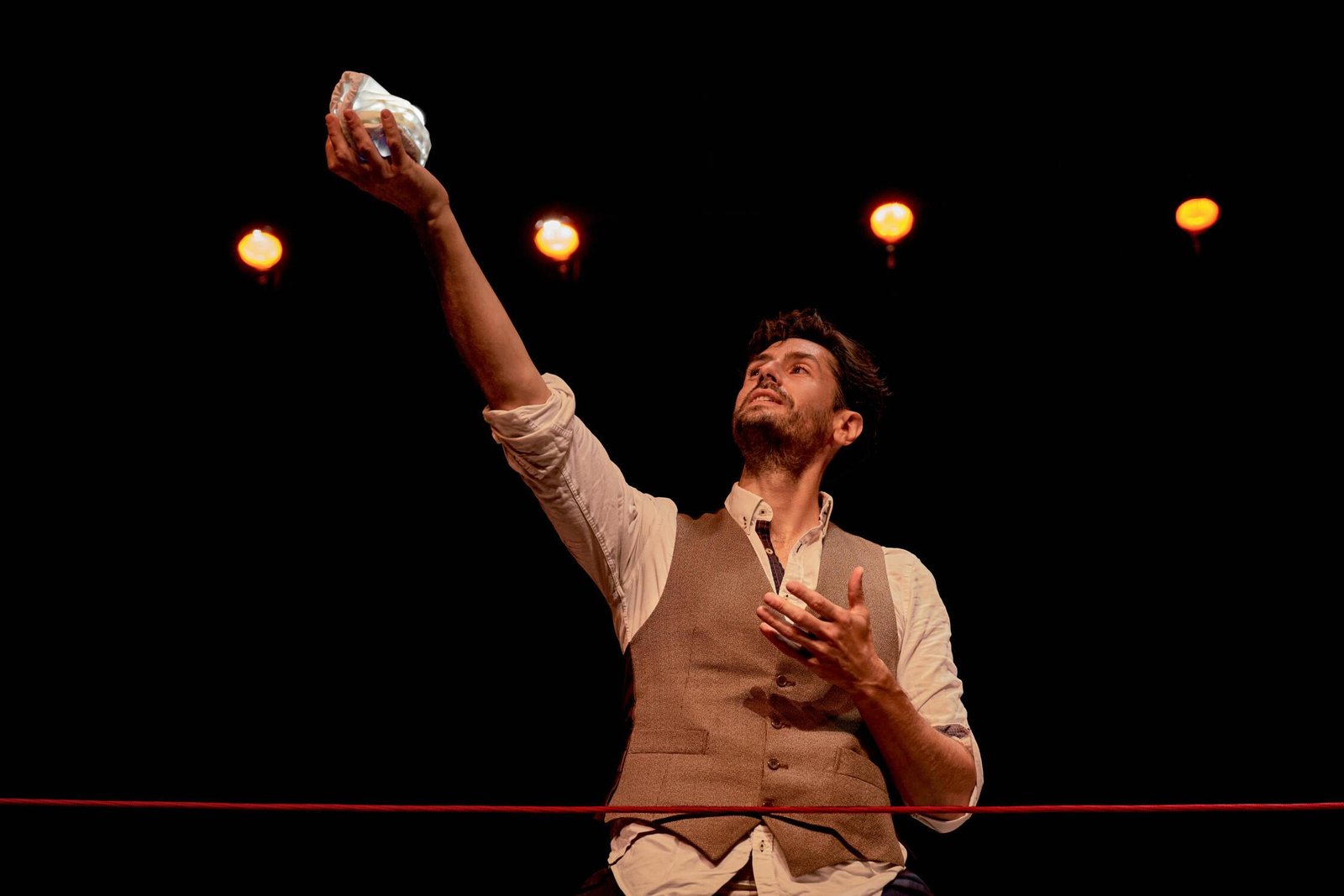
In his biography of Federico García Lorca, Ian Gibson observes that the writer’s assassination took place on the moonless night of the 18th August — a fact that acquires particular significance for a writer for whom the moon held such significance. Una noche sin luna (A Moonless Night) is the title of this terrific work by actor Juan Diego Botto; it uses the life, death and legacy of Spain’s most important twentieth-century dramatist and poet to reflect on memory, censorship and democracy. Botto creates a Lorca who addresses the audience as a spectre caught between the past and present, endlessly wandering the earth to remind contemporary Spain of the horrors of fascism and what it did to him, and so many like him that were gay, socialist or unwilling to align with the ideology of the right.
Crafted from Lorca’s writings – lectures, letters, poems, and plays – this is a piece where Lorca is effectively in conversation with the audience. For close to two hours, Botto walks the audience through the latter years of Lorca’s life and the circumstances and conditions of his death; it’s not a conventional chronology but rather a focus on different episodes from a life that resonate with present-day Spain. The piece was first produced in 2021 but it’s possibly more pertinent now, as far-right party Vox’s political alliances with the People’s Party have had strong implications on artistic freedom and cultural programming. Lorca emerges from the grave in which, he states without rancour, he has been “abandoned” to make the case for culture as a fundamental right, a key part of any society that is willing to reflect on its history and its sense of self.
The opening sees Botto playing with the ambiguity between his own position as an actor known for his activism in the area of human rights and the persona of Lorca as a national icon. Botto’s father, Diego Fernando, was disappeared by the Argentine dictatorship in 1977; the family left for Spain the following year. Enforced disappearance and extrajudicial executions mark the histories of both Spain and Argentina and Botto’s exile becomes a further contextualising element in this narrative. His entry on stage telling the audience that he’s been asked to make cuts to the text by the authorities and would rather cancel the performance than compromise its integrity feels utterly believable. It is only when he circulates a copy of the case against him that it becomes clear that this is Lorca speaking in 1936, sharing with the audience the criticisms made against him that have led to this accusation of defamation of the Civil Guard (Spain’s rural police force) in his poetry.
What follows is Botto/Lorca’s description of a journey to make work that makes a difference; work that that moves hearts and minds. He doesn’t want to “matar el tiempo” (kill time): time doesn’t need to be killed but rather filled with meaning and constructive actions. He provides an abundance of examples of a life lived with purpose. Bystanding and indifference are never an option for Botto’s Lorca.
Botto/Lorca quotes from his incomplete Comedia sin título (Play Without A Title) from which the piece takes much of its discursive tone: “Pero ver la realidad es difícil. Y enseñarla, mucho más” (But seeing reality is difficult. Showing it is harder). He advocates for theatre’s role in bringing the smell of the sea onto a stage. Theatre should be a space where authors and audiences can laugh at themselves a little. He moves across the front of the stage and walks into the aisle to address audience members directly and look them in the eye. He engages them conversation and asks them direct questions. He confesses he had planned initially to just read a few poems but then storytelling gets the better of him.

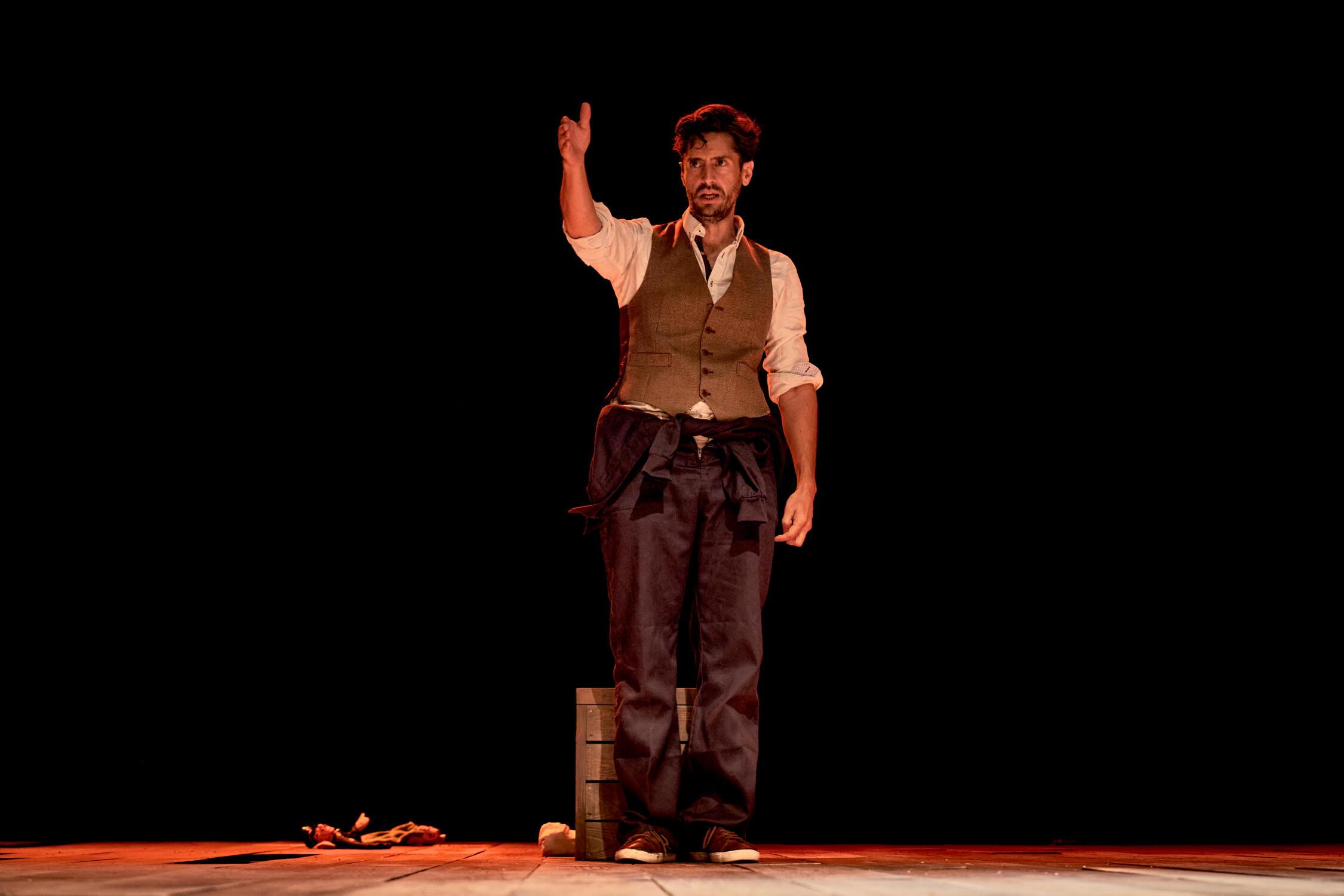
Juan Diego Botto as Lorca speaking to the audience in Una noche sin luna (A Moonless Night). Photo: marcosGpunto
As he speaks, Botto/Lorca loosens planks of wood on the stage and places them upright to resemble tombstones. They can be seen as ways of marking those who are no long with us, commemorations to the dead that have been denied just burial for decades through a systematic failure to address the issue of mass graves and extrajudicial executions. Spain just ignored the issue and hoped it would just go away, as Alfredo Sanzol notes in his 2011 play En la luna. But these spectres still haunt the nation’s psyche.
Botto/Lorca reflects on books that observe that Lorca “died” – no mention made to the fact that he was shot. History can never be neutral; language can erase the truth. It was reported that the poet Antonio Machado “went to France”, but this was no day trip for Machado, no beach holiday; he fled into exile to avoid likely imprisonment. Close to half a million Spaniards sought refuge in France in the latter months and immediate aftermath of the Civil War. Botto/Lorca comments at one point in the second half of the piece that “uno no puede ser neutral” (one cannot be neutral).

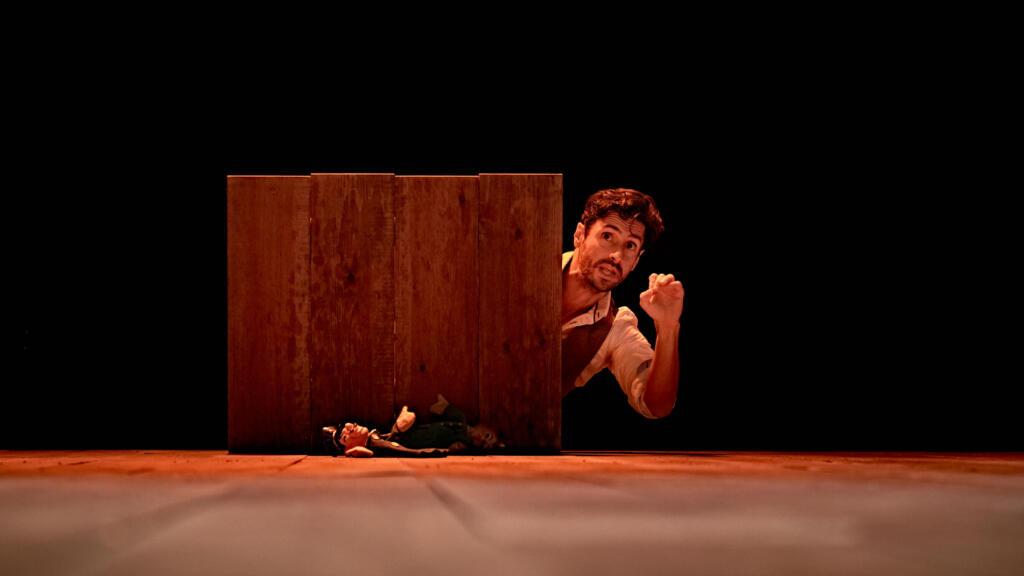
Juan Diego Botto as Lorca in Una noche sin luna (A Moonless Night). Photo: marcosGpunto
Imagination and creativity are at the heart of this production. Botto/Lorca plays a plank of wood as if it were a piano. He asks the audience to prompt him. He asks why he was cancelled – both in relation to works censored during his lifetime and in the aftermath of his assassination. He creates a puppet stage with two hand puppets for Amor de don Perlimplín con Belisa en su jardín (The Love of Don Perlimplín and Belisa in the Garden), enacting a brief scene before narrating that the play was banned as pornographic. Freedom of expression is at stake when, as Botto/Lorca narrates, prison awaits anyone who shows a lack of respect for the Bourbon monarchy.
Art, Botto/Lorca notes, helps people to understand the world. There is delight from Botto/Lorca on being asked to open the local library in 1931. He brings out the boilersuit that was so emblematic of La Barraca, the university theatre company he co-directed which began touring Golden Age works to remote towns and villages in Spain in 1932. He puts the boilersuit on and the insults come thick and fast. For Botto also voices – with a slight shift in tone, demeanour and voice – the antagonistic views of those who made it their business to heckle and make complaints against his works. He talks of being hit and bleeding from the nose with his lover Rafael Rodríguez Rapún intervening to stop the violence. Botto is alone on stage but he conjures a plethora of characters by sporting a jacket or shifting his posture.
A particularly engaging sequence sees Botto become an audience member who gets up from his seat to protest at the nonsensical nature of Lorca’s language. He bemoans the imagery of the language, the nature of artists who live from state subsidies, the murder of Yerma by her husband, that fact that for all Lorca’s so-called progressive ethos, servants litter his plays. Lorca’s life and works are “rewritten” in rage and frustration by this audience member who will not tolerate what Lorca represents He makes a plea for cleansing, evoking the language deployed by the far-right party Vox: “si hay que limpiar, se limpia” (if you have to clean, you clean).
Invoking Theseus, Botto/Lorca provides a thread through memory and identity that runs through the production. Theseus lived on because he was remembered. We are simply what we remember. If history and memory are removed, what remains? In this respect the piece echoes Tiago Rodrigues’ wonderful piece By Heart (first seen in 2013 and still touring). Like By Heart, the piece also asks questions about the intersections between memory and identity and how dictatorships attempt to close down a culture of open discussion. The need to disagree without erasing the other feels particularly pertinent in an age of authoritarian politicians who will tolerate no dissent or deviation from their position. Botto/Lorca laments a country “que cambio la verdad por la victoria” (which exchanged truth for victory) because “hablar de memoria es hablar de identidad” (speaking of memory is speaking of identity). “Yo no me voy a morir” he states at the end of the play. “Yo so soy este país” (I am this country). Una noche sin luna becomes a reflection on Lorca’s status as an icon of progressive Spain, arguably more potent in death than in life.

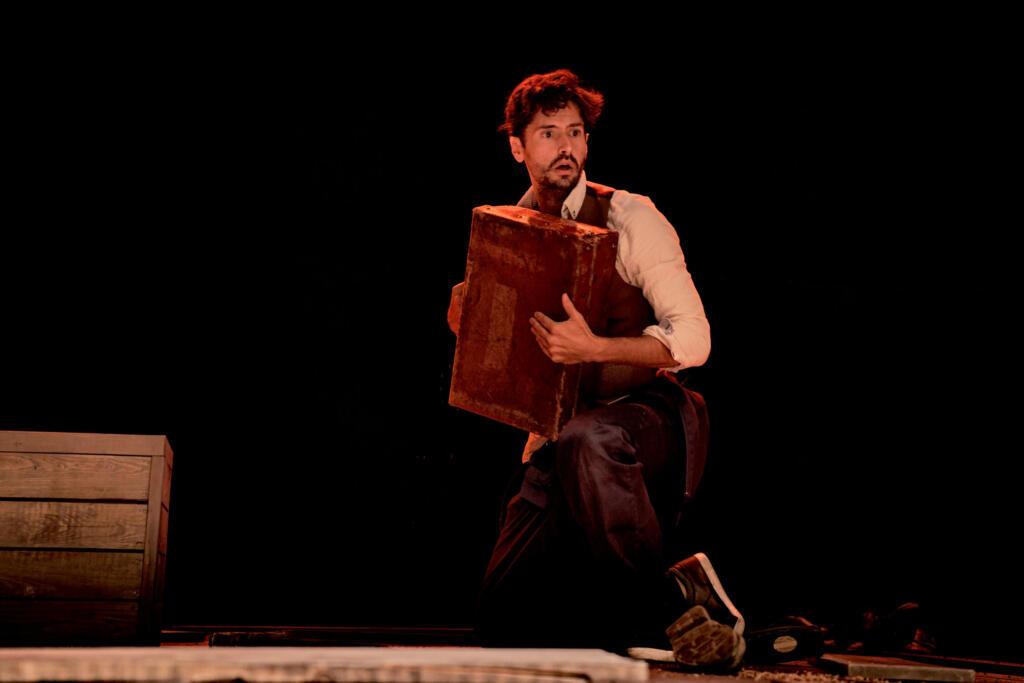
Lorca on the run: Juan Diego Botto in Una noche sin luna (A Moonless Night). Photo: marcosGpunto
Botto/Lorca describes the journey to Granada in 1936 as violence escalated in Madrid in the months leading up to coup d’état that plunged Spain into civil war, the refuge sought in the Rosales family home, and the writer’s murder. The recollection of his assassination comes not with grandiloquent political statements but the remembrance of a first kiss, of Rodríguez Rapún looking at him as “Pequeño vals vienés” (Take This Waltz) plays in Enrique Morente and Lagartija Nick’s visceral recording. The epilogue – a discussion of Rodríguez Rapún’s death, a year to the day after Lorca’s murder– seems to put the piece in dialogue with Alberto Conejero’s 2013 play, La piedra oscura (The Dark Stone), where it is a dying Rodríguez Rapún that recalls Lorca. One moment sees Botto/Lorca appear beneath the ground lit by Raúl Baena in an image that also alludes to Lorca’s idea of a theatre beneath the sand – a raw, direct theatre that strips back to reveal truths and taboos.
Juan Diego Botto gives a remarkable performance: agile, personable, conversational, holding the stage for close to two hours in what feels like a conversation with the audience rather than a performance. Sergio Peris-Mencheta directs with an impressive focus on storytelling to take the audience on a journey where past and present are in constant dialogue and beautifully blurred in ways that feel resonant and timely. Leticia Gañán and Curt Allen Wilmer’s set is an inventive wooden platform where planks are removed and repositioned, and ropes put in place by Botto to enclose the space. The makeshift stage of La Barraca, a ravine, and Theseus’ ship are all evoked by lifting out props buried under the platform – items that also identify those that were killed alongside Lorca: a shoe, a pair of glasses. As Botto removes and replaces the planks, Plutarch’s paradox comes into play: to preserve Theseus’ ship, Athenians replaced rotting planks with new ones by one. To ask whether the ship is old or new appears irrelevant; Lorca’s story is an old one but here it is reconfigured anew, through a different lens, with inventive narrative planks suggesting a cycle of renovation and renewal. Una noche sin luna is a sell-out hit at Madrid’s Teatro Español, and it’s not difficult to understand why. It’s a compelling piece of storytelling that invites its audience to both engage constructively with a difficult past and celebrate the role of culture as a fundamental pillar of any democratic society
Una noche sin luna (A Moonless Night) played at Madrid’s Teatro Español from 30 April to 31 May 2026. It continues touring.
This post was written by the author in their personal capacity.The opinions expressed in this article are the author’s own and do not reflect the view of The Theatre Times, their staff or collaborators.
This post was written by Maria Delgado.
The views expressed here belong to the author and do not necessarily reflect our views and opinions.
