
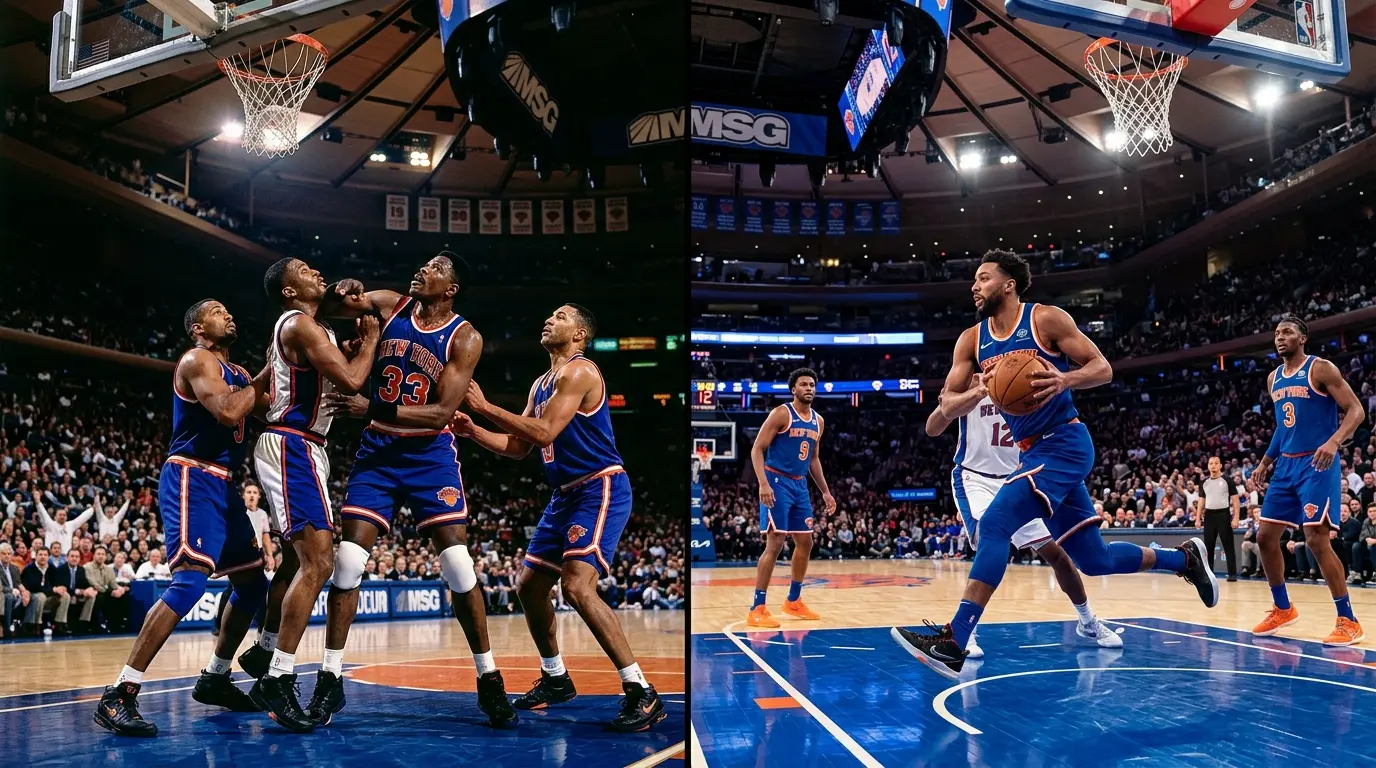

Chris Childs, Charlie Ward, Kurt Thomas, and former GM Ed Tapscott sat down with the New York Post this week and delivered a collective verdict on the 2026 Knicks: this group is better equipped to win it than the team they played on.
Coming from four men who actually made it to the Finals, that’s not nothing.
That optimism is noted. It’s also worth asking whether the guys who lived through the 1999 run are the most objective evaluators of what it takes – or whether they’re simply watching Jalen Brunson and seeing something they wanted badly and never got to finish.
Both things can be true. The question is whether their read holds up analytically.
Let’s find out.
The 1999 Knicks Were a Miracle Run – Not a Blueprint
Before using 1999 as a measuring stick, the honest framing matters: that team was one of the most anomalous Finals runs in NBA history.
The lockout-shortened season compressed everything into 50 games, starting February 5, 1999 – barely two weeks after the labor dispute ended on January 20 – which meant every margin for error was smaller and every hot streak carried more weight.
New York entered the postseason as the No. 8 seed and became the first eighth seed in NBA history to reach the Finals, a feat that wasn’t matched until the 2023 Heat.
They beat a top-seeded Miami team to get there – only the second No. 8 seed ever to upset a No. 1, following Denver in 1994 – then went through Indiana in a brutal Eastern Conference Finals before running into Tim Duncan and a San Antonio machine that won in five games.
Jeff Van Gundy’s crew was navigating a feud between the coaching staff and front office playing out in the press, a roster that had just integrated Latrell Sprewell and Marcus Camby, and constant rumors about Van Gundy’s job security.
They described those playoff battles with the Heat and Pacers as “hand-to-hand combat.” That’s accurate. It was also chaotic in ways that made the run improbable rather than replicable.
The 1999 Knicks were remarkable. They were not a model of organizational stability. That distinction matters when evaluating what the current group is doing.
Why the 1999 Veterans Think This Group Is Built Differently
The piece from the Post includes a genuinely compelling angle: Charlie Ward‘s son is now part of the current Knicks’ orbit, and the former players have a personal connection to this group that goes beyond simple fandom.
That context shapes how they’re watching – and what they’re seeing.
“hand-to-hand combat”
– Description used by 1999 Knicks players on their playoff battles with the Heat and Pacers
What the 1999 veterans are pointing to, per the Post, is a belief that this version has more structure, more talent, and a more reliable engine in Brunson than their team ever had at point guard.
That’s a defensible claim. The ’99 team’s floor general situation was functional, not elite. Brunson is something categorically different.
Even Jeff Van Gundy – the coach of that Finals team – told The Athletic that “there’s never been a Knicks team this dominant.”
When the guy who coached the last New York team to get here is volunteering that this group is better, the veterans backing it up carries actual weight.
That’s not nostalgia talking. That’s people who understand the Eastern Conference at its nastiest saying this roster has things theirs didn’t.
The honest qualifier: former players tend to believe the current team’s success validates their own legacy.
It’s not cynicism to note that – it’s just how sports memory works. But in this case, the analytical evidence largely supports what they’re saying.
Where the 2026 Knicks Have a Structural Edge the 1999 Team Never Had
The most important structural difference is seeding and path. The 1999 Knicks were an eighth seed running on adrenaline and chaos.
The 2026 Knicks earned their Finals appearance from a position of genuine organizational strength – and as our Sixers playoff coverage noted, this franchise hasn’t made a second-round sweep since that 1999 run, which tells you how long and how hard this rebuild has been.
The roster depth is real in a way the ’99 team’s never was. Van Gundy needed Sprewell and Camby to click immediately after being added; there was no margin.
This group has layers – multiple initiators, switchable defenders, and a closing unit that can punish mismatches in multiple ways.
The path through the ECF was complicated by injury concerns, but this team found ways to advance anyway. That kind of resilience is structural, not lucky.
Brunson’s role is also different in kind, not just degree. The 1999 Knicks didn’t have a player capable of manufacturing a bucket in the fourth quarter against a set defense with the game on the line.
Brunson does that on back-to-back possessions. The playoff run has generated its share of loud moments, but what matters more is the consistency – Brunson has been exactly who the Knicks needed him to be at every pressure point.
The 1999 team’s ceiling was “survive and advance.” This team’s ceiling is something else entirely.
The Variable That Still Has to Break Right
Mitchell Robinson‘s broken pinky is the immediate concern, and it’s worth naming plainly: a big man playing through a hand injury in the Finals is a genuine vulnerability, not a minor footnote.
The question isn’t whether Robinson can gut through it. The question is whether it limits his rim-protection and rebounding enough to affect the team’s defensive structure at the worst possible moment.
There’s also the broader health picture. The ECF took something out of this group physically – it always does.
The 1999 Knicks were built for physical attrition in a way that required nothing more from them.
This team is built for a higher offensive ceiling, which means any degradation in their best players’ function gets amplified under Finals pressure.
For the positive case to hold, Robinson has to be functional enough, and Brunson’s minutes load – heavy all postseason – has to hold up over a seven-game series if it gets there.
The 1999 group made it to the Finals on impossible odds and came up short.
The 2026 Knicks got here with more firepower, a more stable foundation, and the endorsement of the people who know exactly what it costs.
Now they have to prove the gap between reaching the Finals and winning one.
