
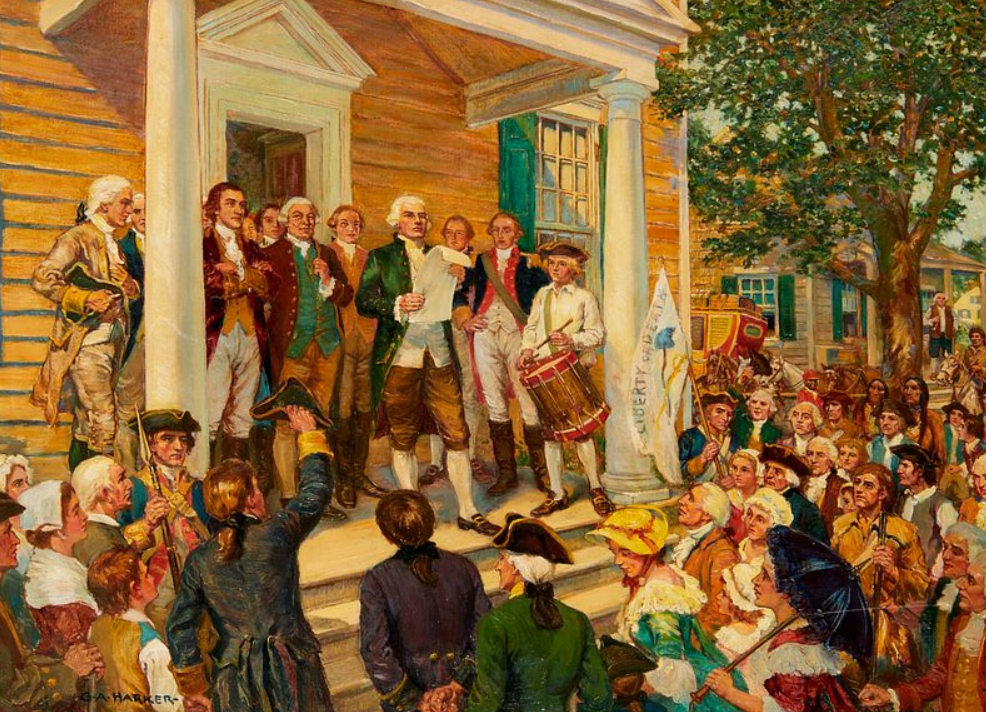
 Conscious of the new political status which the Province of New York had attained by the adoption of the text of the Declaration of Independence by the Second Continental Congress on July 4th, the deputies of the New York Provincial Congress voted unanimously on July 10th:
“That the style or title of this House be changed from that of the Provincial Congress of the Colony of New York to that of the Convention of the Representatives of the State of New York.”
The next day a letter from John Hancock dated July 6th, enclosing the Declaration was “read and filed.” In a reply, drafted on the same day, Hancock was told that his request to have the Declaration proclaimed had been anticipated by two days. At the same time the suggestion was made that the Book of Common Prayer be so modified as to eliminate “all such prayers as interfere with the American cause.”
 On July 9th the Declaration of Independence was read to each brigade of the troops in the city of New York and vicinity on their several parade grounds “by order of Gen. Washington.”
The announcement of the birth of a new nation was not accompanied by the booming of guns and fervid oratory. There was no powder to spare. The troops were not dressed up for a fine parade, for they lacked such uniforms. And the situation seemed too serious for much oratory.
The general order of Washington concluded with these words:
“The General hopes this important event will serve as a fresh incentive to every officer and soldier to act with fidelity and courage, as knowing that now the peace and safety of his country depends (under God) solely on the success of our arms, and that he is now in the service of a State possessed of sufficient power to reward his merit and advance him to the highest honors of a free country.”
The proclamation of independence in and about New York City was received with demonstrations of delight, ringing of bells and jubilant shouts.
Destruction of the King’s Statue
On the night of the 9th the new enthusiasm produced by the issuance of the Declaration expressed itself in a demonstration. The gilded leaden equestrian statue of King George III was dragged from its base in the Bowling Green. Later, parts of it were molded into bullets in Connecticut. The horse’s tail is held by the New-York Historical Society.
 (The stone slab on which the statue stood was taken to Powles Hook in 1783. Later it served as a marker for the grave of Major John Smith of the 42d Highlanders, and still later as a doorstep of Cornelius Van Vorst of Jersey City. It eventually came into the possession of the New-York Historical Society together with the tail of the horse and part of the saddle. The white marble pedestal was removed from Bowling Green in 1818.)
Washington mildly rebuked the troops for this act, and while appreciating the motive, ordered that for the “future these things shall be avoided by the soldiery.”
Captain John Montressor (1736-1799), chief engineer of the British army in America at the time, recovered the mutilated head of the king and sent it to George Townshend, 4th Viscount Townshend (later created 1st Marquess Townshend) “in order to convince them at home of the infamous disposition of the ungrateful people of this distressed country.”
New York-Wide Public Celebration
The city of New York’s Committee of Safety ordered “That at 12 o’clock on Thursday, the 18th inst. at the City Hall, in this city, the aforesaid Declaration be published, when and where it is hoped every true friend to the rights and Liberties of this country will not fail to attend.”
 Hence the “Declaration was read at the City Hall, July 18, 1776, to a numerous and respectable body of the freeholders and principal inhabitants of this city and county and was received with general applause and heartfelt satisfaction; and at the same time our late King’s Coat of Arms was brought from the Hall, where his courts were formerly held, and burned amidst the acclamation of thousands of spectators.”
A good example of how the news about the Declaration of Independence was carried over the State is supplied in the records of the Albany County Committee.
The minutes for July 17, 1776, give this entry: “Received a Letter from Abraham Yates Junr, Rob. Yates and Matthew Adgate dated White Plains 14th Instant, enclosing the Declaration of the United States of America, declaring the said United States free and Independent, also the Resolution of the Representatives of the State of New York.”
 The next day it was “Resolved That the Declaration of Independence be published and declared in this City to morrow at Eleven O’Clock at this place, and that Col. [Goose] Van Schaick be requested to order the Continental Troops in this City to appear under Arms at the place aforesaid and Farther that the Captains of the several Militia Company’s in this City be requested to Warn the Persons belonging to their respective Companies to appear at the place aforesaid and for the purpose aforesaid.”
(Goose Van Schaick (1736 – 1789) had just been appointed Commander of the 1st New York Regiment and was the officer responsible for the Continental troops stationed in Albany.)
On July 19, 1776, “Pursuant to a Resolution of Yesterday the Declaration of Independency was this Day read and published at the City Hall to a large Concourse of the Inhabitants of this City, and the Continental Troops in this City and received with applause and satisfaction.”
The records are lacking for other villages and towns, and the country districts of the State, but there can be little doubt that these communities followed the example of New York City, White Plains and Albany, and that the military officers outside the region of the metropolis carried out Washington’s orders when they were received.
Patriots & Traitors
The Continental Congress on July 19, 1776, ordered the Declaration of Independence “engraved on parchment” and signed. The signatures were affixed on August 2d and later. The document bore the names of four New Yorkers — William Floyd, Francis Lewis, Philip Livingston and Lewis Morris.
 The New York Provincial Convention on March 6, 1777, received a letter from John Hancock dated Baltimore, January 31, 1777, enclosing a copy of the Declaration of Independence with the names of all the signers and a resolution that the same be put on record and preserved in the state archives. It was printed in the records of that body.
The Declaration of Independence gave finality to the Revolution. It forced every American to take a stand. Either he must acknowledge himself a Loyalist and hence a champion of oppression and tyranny and a traitor to the United States, or else he must join his fellow countrymen for a new order. No man was permitted to remain neutral.
John Alsop (1724-1794), a New York delegate to the Continental Congress, believed that a door should be “left open for a reconciliation with Great Britain.” Now that the “Declaration closed the door,” he resigned his seat on July 16th.
“The Tories dread a Declaration of Independence… more than death itself,” wrote a Whig. Now there could be no compromise, for force and not logic must decide.
The unity of the British Empire was the supreme issue. After July 4, 1776, the Loyalists, as they called themselves, or Tories as they were designated by the revolutionists, were outcasts from their own homes and outlawed as traitors by the State.
If true to their convictions, no other course was open to them than to pray and to work for the defeat of the patriots and the victory of imperial arms. Thousands of them joined the British army to wage war on their former neighbors and kinsmen.
Other thousands suffered in prison or lived hated and suspected under parole. Still other thousands fled as exiles to Nova Scotia, Newfoundland, Canada, the Bahama Islands and Great Britain.
 Their property was confiscated by the new State, and although partially repaid by the British government for their losses, they had to begin life anew in a strange land.
The common “one-third” estimation for Loyalists comes from John Adams’s later letters, but modern scholarly estimates place the actual percentage significantly lower with dedicated Revolutionaries accounting for about 40% of the population, Loyalists 15% to 20%, and the remaining 40% to 45% remained neutral or fence-sitting.
Many of New York’s Loyalists made the best of the situation, conformed to the new political order and in time became good citizens of the State.
A Revolutionary Idea Unfinished
The Declaration of Independence instilled a new spirit in the hearts of the patriots. It is true that now they had to fight their former neighbors and relatives as well as the British troops and hired soldiers (Hessians) from the continent, but they had a goal worthy of their best endeavors.
 Defeat meant punishment and retaliation together with the loss of the American cause. Military victory alone could win for them the triumph of the liberties, principles and free institutions for which they had been contending for years. Consequently civilians and soldiers alike were now imbued with a new vision and a greater determination to win.
A new social and political order began to emerge. Some of the poorer class of white colonists began to gain some civil rights.
Some landless tenants bought the lands confiscated from the rich Tory landlords, though the feudal land system would remain in New York until the Anti-Rent War ended in 1845.
The right to vote was extended to thousands who had never enjoyed the privilege (though only landowners, and not women, Black Americans or Indigenous people) and a new set of leaders came to the front in all parts of the State.
White men who were property owners were originally made eligible to vote in New York State in 1777. Black men were also initially included under the same property requirements, but their privilege was specifically limited during the NYS Constitutional Convention of 1821 when they were required to own property valued at least $250 and be a resident for at least three years.
This property requirement was the inspiration of Gerrit Smith and John Brown‘s support of the Black Tibuctoo settlement near Lake Placid. New Yorkers who could vote, rejected statewide ballot measures to eliminate the Black property requirement in 1846, 1860, and 1869.
Black men were legally granted the right to vote on equal terms with white men in New York after passage of the 15th Amendment in 1870.
Women won the right to vote in New York State on November 6, 1917, while Native people gained the right to vote in 1924. Full and legally protected voting access for all New Yorkers was not firmly established until the passage of the federal Voting Rights Act of 1965.
Nonetheless, out of the chaotic transition period of rule by committees and congresses before the Declaration of Independence gradually arose New York State government. As limited as it was, this document signaled a revolution in the ability for the governed to create a constitution of their choice and organize a government through which they could make their own laws.
Read more about the American Revolution in New York or The Declaration of Independence in New York.
This essay is drawn, with editing and some additions for clarity and accuracy, from Peter Nelson’s “The American Revolution in New York; its political, social and economic significance. For general use as part of the program of the Executive committee on the one hundred and fiftieth anniversary of the American revolution,” published by the University of the State of New York’s Division of Archives and History in 1926.
Illustrations, from above: “The Birth of the State of New York” by George A. Harker (ca. 1915), depicts the first public reading of the Declaration of Independence in New York, on the White Plains courthouse steps July 11, 1776; Declaration of Independence being read out to NYC troops on July 9, 1776; Patriots pulling down the Bowling Green statue of King George III on July 9, 1776; a marble plaque installed during the centennial of American independence (1876) marks the spot where the Declaration of Independence was read in front of the Albany Staat Huys (State House, Albany’s City Hall) by Matthew Visscher on July 19, 1776; the plaque, now located at SUNY Plaza – the former D&H Building – in downtown Albany, reads: “The Declaration of Independence was first read in Albany by order of the Committee of Safety July 19, 1776 in front of the City Hall then on this site. This memorial of the event was placed here by the citizens July 4, 1876”; copies of the original Declaration and a broadside printed in 1776; “Encampment of the loyalists at Johnstown on the banks of the river st Lawrence in Canada June 6, 1784” by James Peachey (American Revolution Institute – Society of the Cincinnati); and Continental soldiers raid a Loyalist home during the Revolution.
