
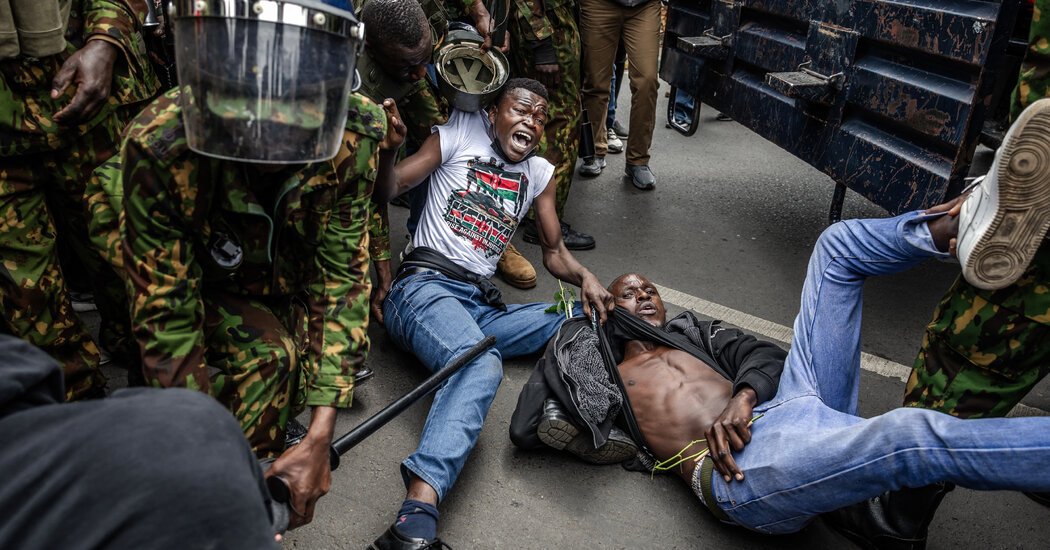
The authorities in Kenya effectively shut down the capital, Nairobi, on Thursday, blocking highways and deploying security forces to pre-empt an annual protest that has become a focus of opposition to President William Ruto.
June 25 has emerged as a significant — and tense — date in Kenya’s political calendar, after security forces killed dozens of people on that day two years ago during a protest against a government finance bill that would have raised taxes.
On Thursday, fears of unrest and possible police violence forced most shops, businesses and schools to close, replacing the city’s usual bustle with an eerie quiet. Interior Minister Kipchumba Murkomen had warned a day earlier that looters or anyone engaging in criminal acts would face the full force of the law.
At the protest on Thursday, a few dozen demonstrators, seeking to commemorate the people killed at previous protests by laying wreaths at Parliament, arrived at the center of the city by midday. They were heavily outnumbered by the police, according to witnesses.
“Across the country, people were supposed to march, but the president has closed down the country,” said Boniface Mwangi, a protest organizer. Issa Mohamud, Nairobi’s police chief, told journalists on Thursday the roadblocks were intended to keep criminals from the city.
Security forces blocked the marchers, including Kalonzo Musyoka, a possible presidential candidate, from entering Parliament grounds. The protesters instead placed the wreaths on the razor wire the police had strung outside the compound.
The protest commemorated the more than 60 people killed by the security forces during big demonstrations in Nairobi and other cities two years ago that shook the country and were a turning point for Mr. Ruto’s government.
Those protests, staged partly under the banner of the loosely organized Gen Z movement, were set off by opposition to the proposal to raise taxes in a country where many people face severe financial hardship. But the marches also reflected economic frustration, political disillusionment and anger at tough police tactics.
After the protests, the government withdrew the finance bill, but dozens of people were also killed during commemorative protests last year. The government has acknowledged that the security forces killed people, but it has disputed the numbers and defended police action as self-defense.
That unrest displayed the rising power of young people as a political force in Kenya and the ability of social media to galvanize the movement, enabling protest organizers to quickly gather people onto the streets and amplifying messages through memes and videos.
Gen Z protests have also swept other African countries, including Morocco and Madagascar, where the president was ousted last fall as part of a broader wave of political mobilization by young people that has touched countries as far apart as Nepal and Peru.
This year’s protests, while smaller than in previous years, come as presidential elections are expected next year. Mr. Ruto, who was first elected in 2022, plans to seek re-election for a second and final term against an opposition that has yet to decide on a candidate.
Several residents of Nairobi said in interviews that they were deterred from participating in the demonstration because of a fear of police violence and of armed gangs, known informally in Kenya as “goons,” whose leaders have said in interviews that they are paid by politicians to disrupt opposition rallies.
The interior minister, Mr. Murkomen, later told journalists that 355 people had been arrested around the country during protests, including 161 in the capital. He gave no details of possible casualties. The police also used tear gas to keep a small group of protesters from the central police station, witnesses said.
In a bid to address the protest deaths, the government this month announced a compensation fund of 2 billion Kenya shillings (roughly $15 million) for civilians and security personnel killed or harmed in protests since 2017.
Some victims welcomed the fund but said it was no substitute for justice.
Gillian Munyao, the mother of Rex Masai, who became a national symbol as the first protester to be killed in the 2024 protests, joined other mothers in laying a wreath near Parliament. She carried a placard that read: “Compensation cannot replace accountability. Arrest killer cops.”
