
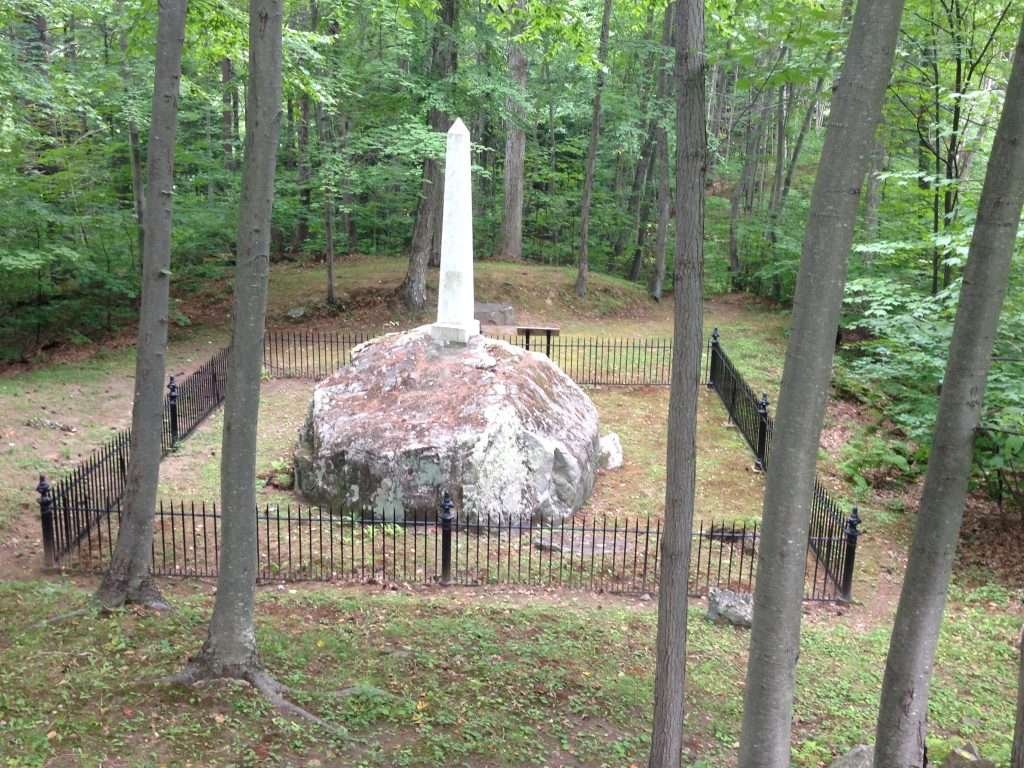
 The Williams Monument lies several miles south of the head of Lake George along Route 9. On September 21, 1921, workers digging a hole for a sign near the obelisk revealed five cannonballs believed to date to the French & Indian War (1754–1763).
Following the unexpected discovery, made in 20 inches of soil, the laborers refilled the excavation. They then dug a post-hole in a different spot.
Melvin J. Ball, described in the September 30, 1921 Salem Press newspaper issue as a “Glens Falls collector,” heard of the find and went to the historic marker. He uncovered four more cannonballs in the initial excavated pit.
Ball acquired the original five cannonballs and with the four he unearthed, that totaled nine cannon shots. However, he reportedly gave a single artillery ball to one of the workers.
Melvin J. Ball suggested the artifacts were from the 1755 French military force commanded by Baron Dieskau, a 54-year-old major general from the German duchy of Saxony. However, Ball’s theory about the colonial ordnance may be incorrect.
 In 1854, Williams College graduates erected a monument near the site where Colonel Ephraim Williams, a 40-year-old provincial officer, died in battle in 1755. The Massachusetts soldier was killed by French soldiers and their Indigenous allies during Bloody Morning Scout, the first combat of the September 8, 1755 Battle of Lake George.
The marker commemorated the life and death of Williams. His will provided funds to establish an educational institution. After many delays, Williams College was finally established in 1793. Located in Williamstown, Massachusetts, the school today has about 2,150 students and it is one of the best liberal arts colleges in the country.
News coverage of the unearthing of the relics at the Williams Monument in 1921 did not indicate if the nine cannonballs were marked with the French fleur de lis or the British broad arrow. One news story reported that the cannonballs were eight-pounders. If so, they may have been French as the British military’s closest ordnance of that size was the nine-pound cannonball.
Dr. Russell P. Bellico, author of the 2010 book, Empires in the Mountains: French and Indian War Campaigns and Forts in the Lake Champlain, Lake George, and Hudson River Corridor, told this writer “Dieskau’s army brought no cannons to the head of Lake George from the French forts in the Champlain Valley. Thus, the 1921 report that the cannonballs were French is puzzling.”
Dieskau’s military detachment was defeated in the 1755 Battle of Lake George. It was one of the few British victories early in the French & Indian War.
 It is more likely that the cannonballs found at this site over a century ago were British and their caliber was incorrectly identified in 1921. The artillery projectiles may have been lost from British wagons that traveled the military road from Fort Edward to Lake George during the French & Indian War.
Another possibility is the ordnance could have been abandoned during two French ambushes of British supply wagons along the military road in late-July 1758, just days after British General James Abercromby’s army was defeated at French-held Fort Carillon (now Fort Ticonderoga).
Furthermore, the cannonballs could even have come from British or American military operations during the Revolutionary War (1775–1783).
Today, historic-preservation laws make it illegal to collect historic artifacts at this site.
Read more about the history of Route 9.
A version of this article first appeared on the Lake George Mirror, America’s oldest resort paper, covering Lake George and its surrounding environs. You can subscribe to the Mirror HERE.
Illustrations, from above: Ephraim Williams Monument as it appears today; F.C. Yohn’s painting of the death of Colonel Ephraim Williams at ‘Bloody Morning Scout’ on September 8, 1755; and the Williams monument in 1911 (New York State Archives).
