
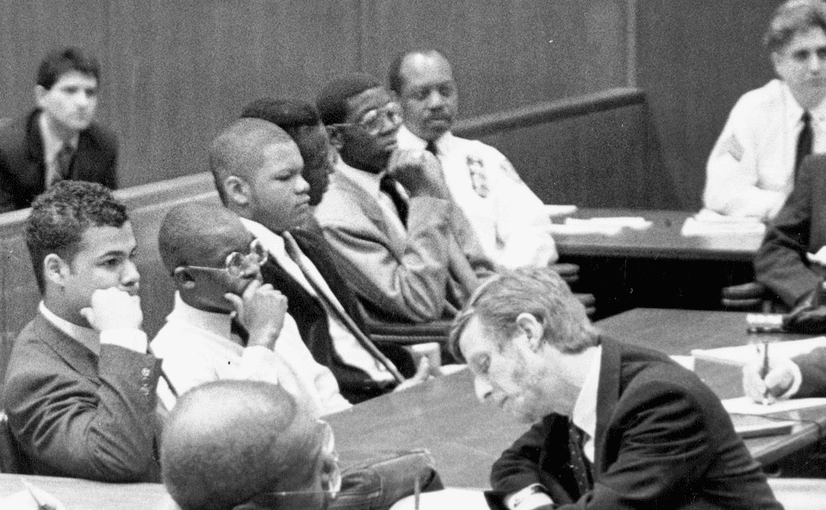
 On April 19, 1989, a white woman was brutally raped and beaten in New York City’s Central Park. Police officers soon arrested a dozen young men and eventually charged five teenage boys ranging from 14-16 years of age.
Police subjected Kevin Richardson, Raymond Santana Jr., Korey Wise, Yusef Salaam, and Antron McCray to hours of intense interrogation and ultimately extracted confessions.
Each of them later recanted and insisted that he had been coerced into making false confessions despite having no involvement in the crime.
Though there was no physical evidence to link them to the attack, all five boys were convicted of attempted murder and rape and sentenced to prison terms ranging from 5 to 13 years.
From the time of their arrest, many observers and commentators readily believed that this group of teenage boys — four who were Black and one who was Latino — had committed the attack and deserved the harshest possible punishment.
The five teenagers convicted of the Central Park attack faced a presumption of guilt and dangerousness rooted in America’s history of slavery and lynching, which remains with us today and leaves minority communities particularly vulnerable to the unfair administration of criminal justice.
Donald Trump, then a well-known businessman in New York City, took out multiple full-page newspaper ads denouncing the Central Park attack, praising the power of hate, and demanding officials “bring back the death penalty” as a defense against “roving bands of wild criminals.” Trump went on to win election to the White House in 2016 and 2024.
At the time of the Central Park case, the idea of the young, non-white “super-predator” was gaining legitimacy among criminologists and policymakers. In January, 1996 speech then First Lady Hillary Clinton blamed “kids that are called super-predators” for American crime.
By stoking unsubstantiated fears of increasing violence and criminality among Black children, researchers built support for harsh proposals to abandon the juvenile system’s focus on rehabilitation and instead funnel younger and younger children into an adult system primarily focused on punishment.
One result was the Violent Crime Control and Law Enforcement Act of 1994, which was widely supported by both political parties. Joe Biden, who would serve as President from 2021 to 2025 had introduced the bill in the Senate. The bill was signed into law by Bill Clinton, who served as President from 1993-2001.
Eexoneration & Police Denials
In 2002, another man confessed to the rape and beating committed in Central Park 13 years before, and DNA evidence confirmed his guilt.
That same year, New York Supreme Court Justice Charles J. Tejada granted the motions of defense attorneys and District Attorney Robert Morgenthau, vacating the convictions of the “Central Park Five.”
Police detectives nevertheless continued to maintain that the defendants were accomplices in the assault and refused to admit misconduct for their handling of the case.
After their convictions were vacated, all five of the young men had completed their prison sentences but still faced the difficult journey of rebuilding their lives and recovering from spending years of their childhoods imprisoned for a crime they did not commit.
They ultimately sued the city for malicious prosecution, racial discrimination, and emotional distress.
“You all don’t really understand what we went through,” Kevin Richardson said. “People called us animals, a wolf pack…It still hurts me emotionally.”
New York City refused to settle the suits for over a decade, but in June 2014 agreed to pay the men $40 million in damages.
In 2019, 30 years after the five teens’ arrests, a Netflix mini-series dramatically depicted their ordeal and continuing struggle to recover, sparking renewed interest in the case’s history and its connection to injustice and racial bias still plaguing our courts and prisons.
“I was shocked, because I had no idea that something like this could happen to anyone—especially people who were my age at the time,” Ethan Herisse, who played Yusef Salaam in the mini-series, said in an interview after completing production.
“I’m at a different place now, where seeing that this thing happened and is still happening, even now — if I were going to be put anywhere near our system, I wouldn’t feel completely safe,” he said.
To learn more about the wrongful arrest, prosecution, and imprisonment of Kevin Richardson, Raymond Santana Jr., Korey Wise, Yusef Salaam, and Antron McCray, watch Ava DuVernay’s mini-series “When They See Us.”
Or read Sarah Burns’ book The Central Park Five: The Untold Story Behind One of New York City’s Most Infamous Crimes (2012).
A version of this essay by the Equal Justice Initiative appears in their History of Racial Injustice calendar. EJI works to end mass incarceration, excessive punishment, and racial inequality. If you would like to sign up for the daily calendar by email subscribe here.
Photo: The Central Park Five in court (by James Estrin for The New York Times).
