
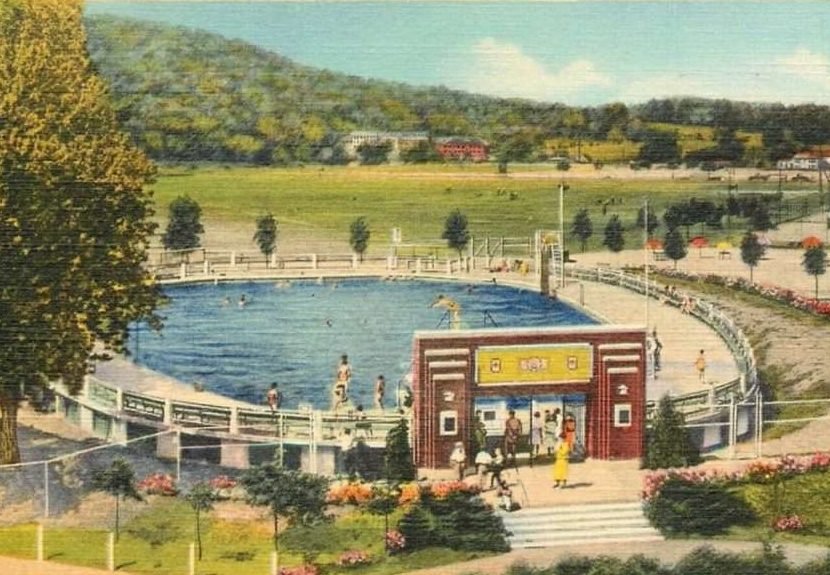
 Wesley Bintz was a Civil Engineer who received his training at the University of Michigan, earning a BCE in 1916 and MS in 1918. He moved on to municipal work in Flint, Michigan with two pools made of reinforced concrete, and funded by municipal bonds, which he designed as their City Engineer and completed in 1920.
Bintz subsequently accepted an Engineering position with the City of Lansing, Michigan whose citizens also desired an ovoid swimming pool, and saw their aspiration fulfilled with another a Bintz designed 80 x 120 foot pool constructed during 1922-23. Other communities saw the need for such facilities, which caused Bintz to patent his design, and specialize in his own swimming pool enterprise. Many Blintz pools were built in New York State.
The recently completed New York State Barge Canal had popularized the use of reinforced concrete, which was used not only for the canal’s locks, but also in lighthouses, bridges, electrical powerhouses and even transmission poles.
 The Bintz pools could be constructed in any shape, with the rectangular and ovoid being the most popular. As public pools they needed to provide both deep water for diving, with the greater portion being of a wadable depth, which gave the ovoid shape an advantage as the smaller end was deeper water, and a larger proportion of the pool was used for the greater share of the public.
A further advantage of the ovoid shape was that the pool walls were shorter by comparison than rectangular, making them more economical to construct. The ovoid shape was not truly egg-shaped but had squared ends, to provide equal competition lanes.
Very little excavation was required to construct a Bintz Pool, which the designer was quick to tout, and a standardized baseline of design brought down the cost, and made the price affordable.
 Construction of the above ground pool would begin with a reinforced concrete floor with drains. The pool tank, was next constructed, followed by the exterior walls, with these two vertical elements being joined by a reinforced concrete deck that provided the overhead cover for the locker rooms, showers and toilets below, and a concourse that surrounded the pool above.
The exterior walls could be clad with masonry, and could be extended above the pool deck, forming a parapet around the swimming area. This made the Bintz design ideal for country clubs or parks by eliminating the need for an unsightly fence.
The Bintz advertising documents, which introduced so many municipalities to the notion of an above ground pool, asked prospective customers to envision an overturned straw boater hat or skimmer as the pool tank, and the brim as the deck around it.
The Bintz Pools would typically have a single entrance; often this portal was surrounded by an embellishing archway or columns where plaques were placed to commemorate those who were locally responsible for bringing the pool to reality.
Admission would be charged just inside and the cost to the patron would include a deposit for the key to a locker, which would be suspended along with a brass identification tag, from a large safety pin that was attached to the swimmer’s suit.
 At the lobby entry area counter bathers divided, men and boys going to facilities to the right, and women and girls to the left. The lobby would also contain a stairway to a sequestered spectator area, where those not bathing could observe from the pool deck.
Bintz planned all his pools with what he termed a “wet path” for swimmers, and a “dry path” for observers, or those not wishing to exit through the locker rooms. The passageway on each side of the pool tank contained changing rooms for the women and benches for the men, with high-set windows providing illumination and ventilation.
There were showers and lavatories on each side, with the farthest end of the passageway/locker room terminating with a staircase up to the pool deck. To prevent tracking debris from the swimmers’ feet, the base of the stairs had a small basin of flowing antiseptic water which had to be stepped through, with a compulsory spray on both sides of the stairway.
Sanitation was a large feature of the Bintz pools, and a filtration/chlorination/boiler room occupied the area between the stairways of each locker room. The perimeter of the pool’s surface was surrounded by what the designer termed “a scum rail,” which collected floating debris as well as the rainwater which fell on the deck. Bathers were encouraged to expectorate (publicly spit) into this device only.
 Bintz Pools in New York State
The first contracts for his patented above ground pools in New York State were in Troy’s Prospect Park, and Elmira’s Brand Park, with ground broken in 1926, for pools similar in size as those first built by Bintz in Michigan.
George F. Johnson (1857-1948) practiced a form of “industrial socialism” with his Endicott-Johnson (E-J) shoe factories in the Binghamton area. He utilized immigrant labor, realizing the valuable resource of mainly Eastern European workers, and hoping to provide them integration to American life.
Johnson, through E-J, provided company-sponsored medical and dental care, housing and mortgages, and bakeries and cafeterias. He created parks containing carousels, libraries, recreation centers and dance pavilions. Critics of Johnson felt his “Square Deal” went to great lengths to keep labor unions out of his shoe factories; however, his benevolence remains legendary in some quarters of New York’s Southern Tier.
 E-J built the largest Bintz Pool designed, in Johnson City’s C. Fred Johnson Park in 1927, with a textured brick exterior and maroon tinted mortar. On the exterior walls, Wesley Bintz often employed Zigzag Moderne, a distinctive genre of Art Deco style that burgeoned in the United States during the 1920s and early 1930s that displayed bold, geometric abstractions for his pools’ architectural facades.
The C.F.J. Pool designer planned to place Johnson’s name below the invitation inscribed over the entryway to, “COME ON IN THE WATER’S FINE” – he declined.
Like many Bintz Pools, the C.F.J. Pool included decorative lamp posts extending above the outer parapet walls, and with large flood lights, allowed swimmers to enjoy mild nights under the stars.
The C.F.J. Pool was designed to contain 695,000 gallons of water. The entire structure covered nearly 34,000 square feet of ground and was considered capable of accommodating nearly 2,000 bathers at one time. The C.F.J. Pool eclipsed Bintz’s other large ovoid pool, built in Rhodius Park in Indianapolis, by having the spectator staircases inside the structure.
These colossal pools were a magnet for young people, in a supervised and safe (and sometimes segregated) compact environment, providing a chance to meet others of similar age from outside their own school district. The municipal pools were the summer place to be for those without the ability or means to travel beyond their urban neighborhoods to get plenty of fresh air, exercise, sunshine and enjoyment.
Watertown built an ovoid Bintz Pool in 1929, originally known as the North Side Pool until 1940, when the benefactor of the pool passed away and the structure was renamed the John Q. Adams Pool.
 In January of 1930, following the market crash just months earlier, Wesley Bintz designed a very large rectangular pool for a project in Harlem called the Lincoln Recreation Centre, which in less than a year was foreclosed upon.
Further east on Long Island, an ovoid Bintz Pool was completed during the 1930 season for another private and commercial complex, the Wal-Cliffe Sporting Club of Elmont, which featured a roller skating rink, sand beach, handball courts, miniature golf and an orchestra pavilion with restaurant attached to the pool concourse.
Newburgh built a Bintz Pool in 1931, when Governor Franklin Roosevelt was part of the dedication ceremony, as his aunt, Annie Delano Hitch had donated the property. This pool has been removed, although the original entry has been incorporated into the new aquatic facility that opened in 2025, as an homage to the original.
In 1940, Bintz signed a contract in Syracuse to build an above ground pool at the Bellevue Country Club.
Following World War II, living memorials to servicemen in the form of sporting venues, parks and swimming pools which served recreational and physical needs became a popular theme, as an alternative to sculptures or monuments.
 Construction materials were in short supply in the immediate aftermath of hostilities, and as an economy and expedient of the postwar period, Bintz reduced the price of projects by using volunteer labor. Most of the peacetime Bintz Pools built in New York State employed the cost-effective precast concrete railings surrounding the swim deck and simplified support posts with utilitarian lighting devices.
The Brand Park Pool in Elmira was seriously damaged by flooding in 1946 and would be rebuilt as a War Memorial. Other War Memorial Bintz ovoid pools would be built in Wellsville in Allegany County, Mount Kisco in Westchester County, North Tonawanda in Niagara County and Binghamton’s First Ward. Broome County’s second Bintz Pool opened in 1950, and Tonawanda in Erie County constructed their World War Two monument, Delaware Pool, in 1954.
Citizens in Callicoon in Sullivan County, grew weary of unsupervised youth drownings in the Delaware River and worked with Bintz to build a pool in 1949, and the Monroe Country Club in Pittsford in Monroe County built a Bintz Pool in 1950.
Unfortunately, nearly all the Bintz Pools in the Empire State became relics of a more civically minded past. Communities feared for their insurance liability in a litigious society, and tradition was victimized by among other things, ambulance-chasing and heavy-hitting attorneys.
The Delaware Community Center Bintz Pool in Callicoon, which was highly modified in 1982, remains operational. The Brand Park Pool in Elmira was demolished in 2025, with the WWII servicemen tribute preserved as a memorial.
Only the Prospect Park Pool in Troy and the Payne Pool in North Tonawanda remain standing, although both no longer function as swimming pools. The Bintz Pools in New York State have been relegated to their past, a time when America truly was great because communities pulled together.
Read more about New York State’s architectural history.
Illustrations, from above: Postcard view of Wesley Blintz designed Annie Delano Hitch Pool in Newburgh built by Bintz in 1931, this pool has been removed, although the original stylized brick entry has been incorporated into the new aquatic facility, which opened in 2025 as an homage to the original structure; Sectional Plan View for the Wesley Blintz designed C.F.J. Pool, showing all 1,592 lockers and other details of the floor plan (Library of Congress); A Wesley Bintz above ground ovoid pool under construction, where elements of the poured-in-place reinforced concrete construction can be seen with the forms and wood “false-work” supporting the forms and reinforcing rods from below that could be used over and over as construction progressed; The entry lobby coat check and locker key counter at the Mount Kisco Memorial Pool in Leonard Park (courtesy Mount Kisco Historical Society); The C. Fred Johnson Pool in Johnson City, NY on a nice day (Library of Congress); The colossal C.F.J. Pool in C.F.J. Park, Johnson City, NY from above; Mount Kisco Memorial Pool in Leonard Park (photo courtesy Mount Kisco Historical Society); and the proposed design for the First Ward Pool in Binghamton, like many other Bintz World War Two War Memorial Pools, it included a sun deck, which also housed commemorative inscriptions, 1949 (Binghamton Press).
