
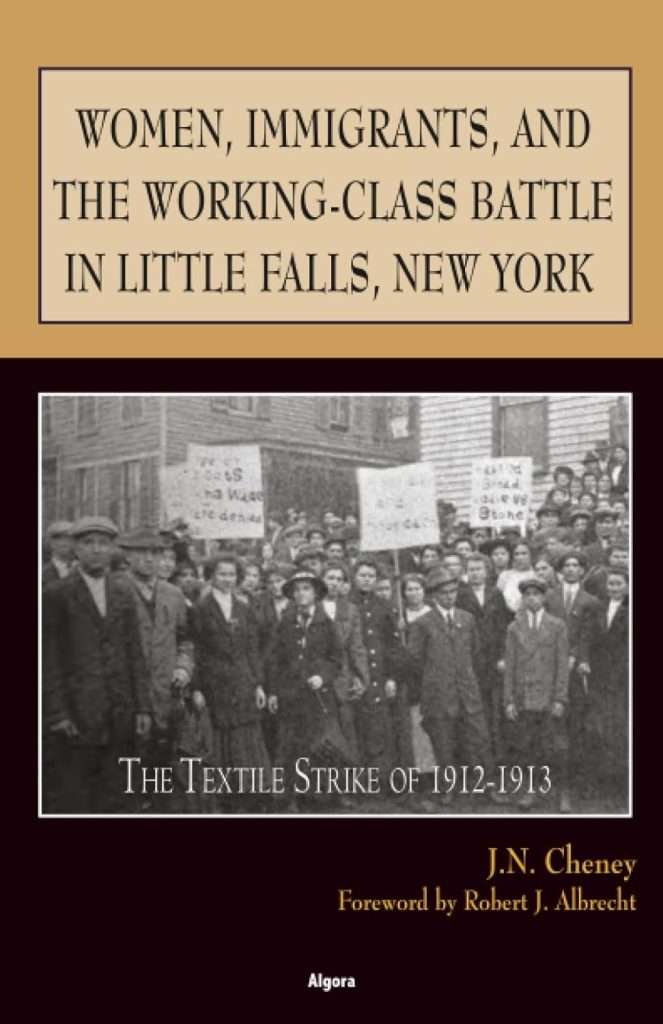
 J.N. Cheney, an independent historian focusing on the labor movement, radical politics, and community action where he lives in the Mohawk Valley has published Women, Immigrants, and the Working-Class Battle in Little Falls, New York: The Textile Strike of 1912-1913 (Algora Publishing, 2025).
This is the first non-fiction book to provide a comprehensive recounting and analysis of the largely forgotten Little Falls Textile Strike, one of the most important events in New York State’s labor history and one with national significance.
Cheney’s first book, his work recounts the political and cultural origins that created the conditions of the strike, including factors such as immigration law and the 1911 Triangle Shirtwaist factory fire, and the legal and political aftermath of the strike.
It also carefully considers the plight of the primarily working-class immigrant women from eastern and southern Europe (mostly Italy, Poland and Slovakia) and their pursuit of better wages and improved working and living conditions.
The book details the horrific conditions they endured — dangerous, unsanitary factories, rampant tuberculosis, and dilapidated tenement housing — which were courageously exposed by nurse, social reformer, and suffragist M. Helen Schloss.
When the workers in two Little Falls mills organized to improve their conditions with the help of the Industrial Workers of the World (IWW, the Wobblies) and the Socialist Party of America, they were met with a brutal campaign of repression.
This new research exposes the police violence, the suppression of free speech by local authorities, and the hostile media coverage that sought to demonize the strikers as dangerous agitators.
The Little Falls Textile Strike did involve several major figures of the early twentieth century labor and socialist movements, providing either direct aid on the picket line or external support through donations and endorsements.
In addition to Schloss, these included IWW organizer Big Bill Haywood, Wobbly and socialist Matilda Robbins/Rabinowitz, Schenectady’s first and only socialist mayor George R. Lunn (for whom there is also a recent biography), Socialist Party leader Eugene Debs, and even socialist activist Helen Keller.
Drawing on extensive archival research, this study resurrects a forgotten history and provides a pioneering theoretical framework for understanding class struggle, nativism, and labor organizing in the Progressive Era, restoring a local struggle to its national importance.
Cheney’s book aims to add a new dimension to our understanding of local history while simultaneously filling a gap in the historiographic realm of the American socialist and labor movements.
Cheney offers a groundbreaking corrective to a pivotal but long-neglected event in American labor history, as it chronicles the dramatic struggle of immigrant women against powerful mill owners, brutal police repression, and a hostile press.
J.N. Cheney’s works have appeared in publications such as New York Archives Magazine, Cosmonaut Magazine, and various other outlets. Robert J. Albrecht, who provides the book’s forward, is a retired Teaching Professor Emeritus and a long time Little Falls resident.
Read more about Labor History in New York State.
