
Anthropic is considering an IPO, according to the Financial Times, right after a series of warnings from senior central bank chiefs and others of a bubble in AI and excess liquidity in a range of asset markets.
At the same time, NEC Director Kevin Hassett has emerged as President Donald Trump’s favorite candidate to replace U.S. Federal Reserve Chairman Jerome Powell next year—signaling further interest rate cuts in 2026 and thus new rounds of cheaper money coming into the market.
And Big Short investor Michael Burry repeated his warning that stocks were in a bubble on a podcast with author Michael Lewis.
Anthropic, which is in talks for a new round of VC funding that would value the AI company at $300 billion, has retained the California law firm Wilson Sonsini to advise it on IPO issues, the FT said, with an eye on going public in 2026. The company denied it has made any such plans.
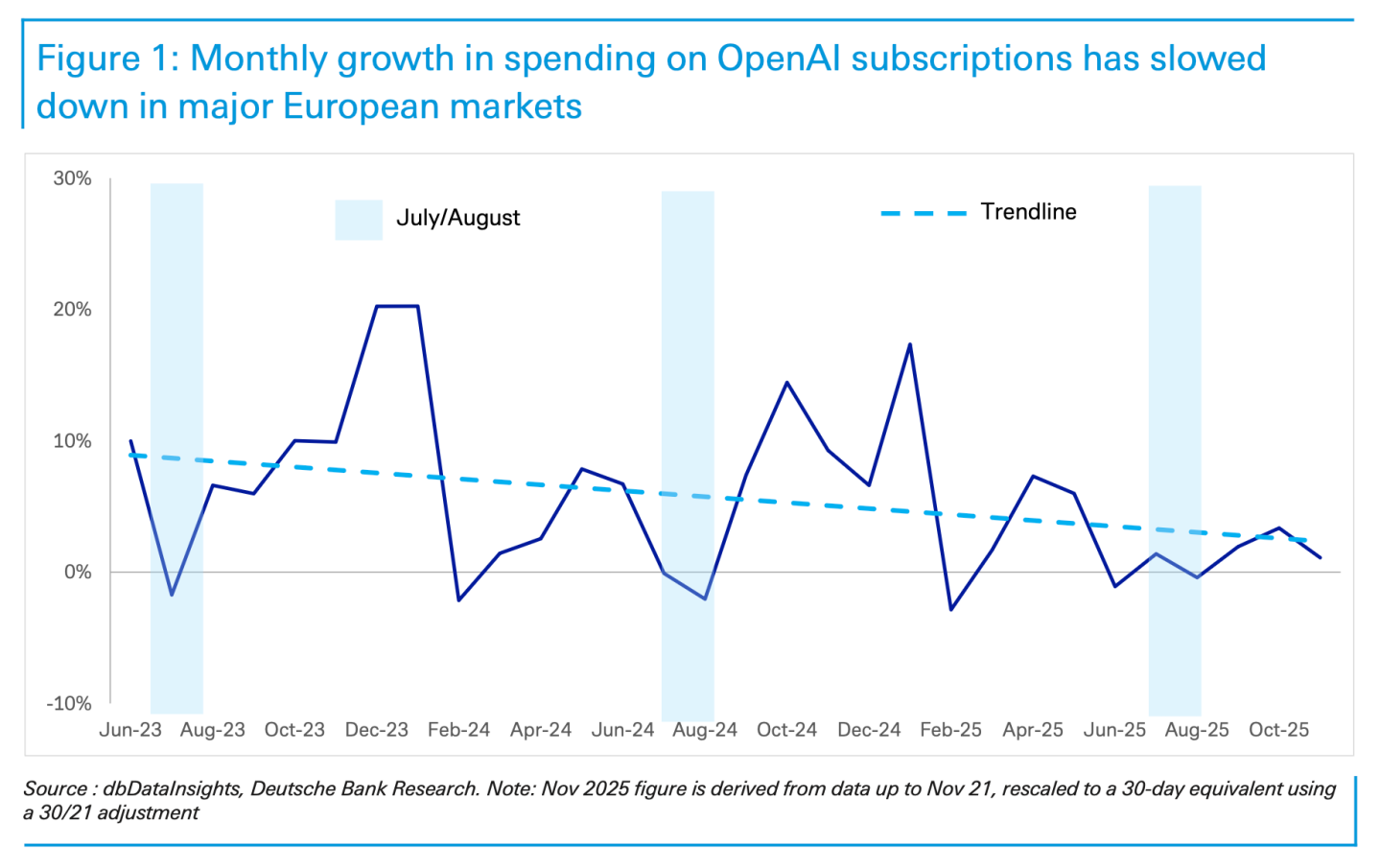
Going public would give the company a vast new war chest of cash with which to compete against Sam Altman’s OpenAI. There is some weakness in OpenAI’s business, according to research made public from Deutsche Bank analysts Adrian Cox and Stefan Abrudan. Growth in consumer subscriptions for OpenAI’s ChatGPT is slowing down, according to data from transaction data from dbDataInsights.
“The value of OpenAI subscriptions in the major European markets declined slightly in June and has been little changed since then … Unlike in the past two years, the pace of growth has not increased long after the annual summer slowdown, suggesting that the subscription model may be saturating,” they said.
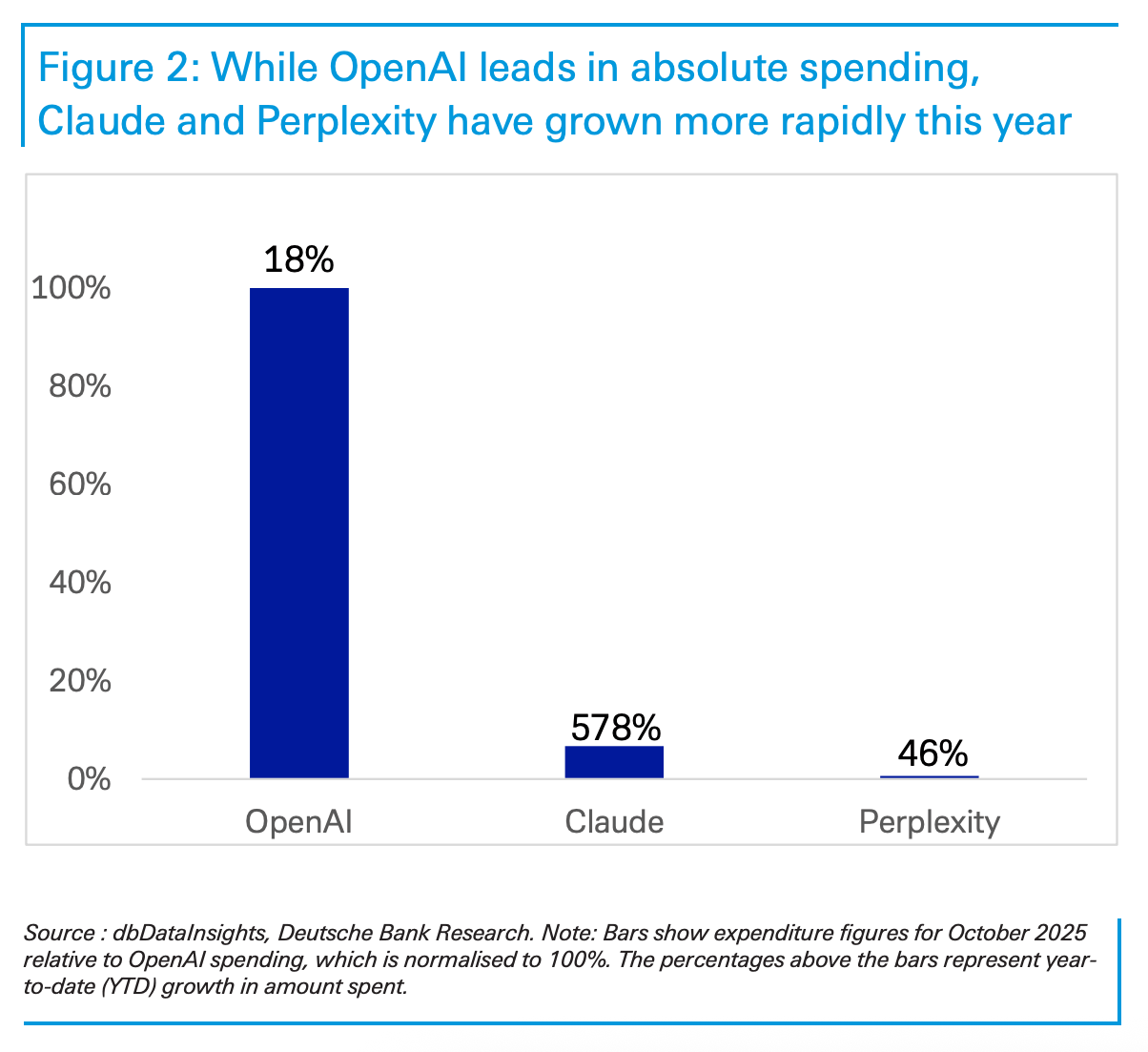
At the same time, growth in subscription value has rocketed at Anthropic and Perplexity—although both of those large-language models have a smaller number of customers, Deutsche Bank’s data shows.
“The new data also show that the value of OpenAI subscriptions has increased 18% this year, compared with a near sevenfold increase in Anthropic’s Claude and 46% gain in Perplexity from much smaller bases,” the pair wrote.
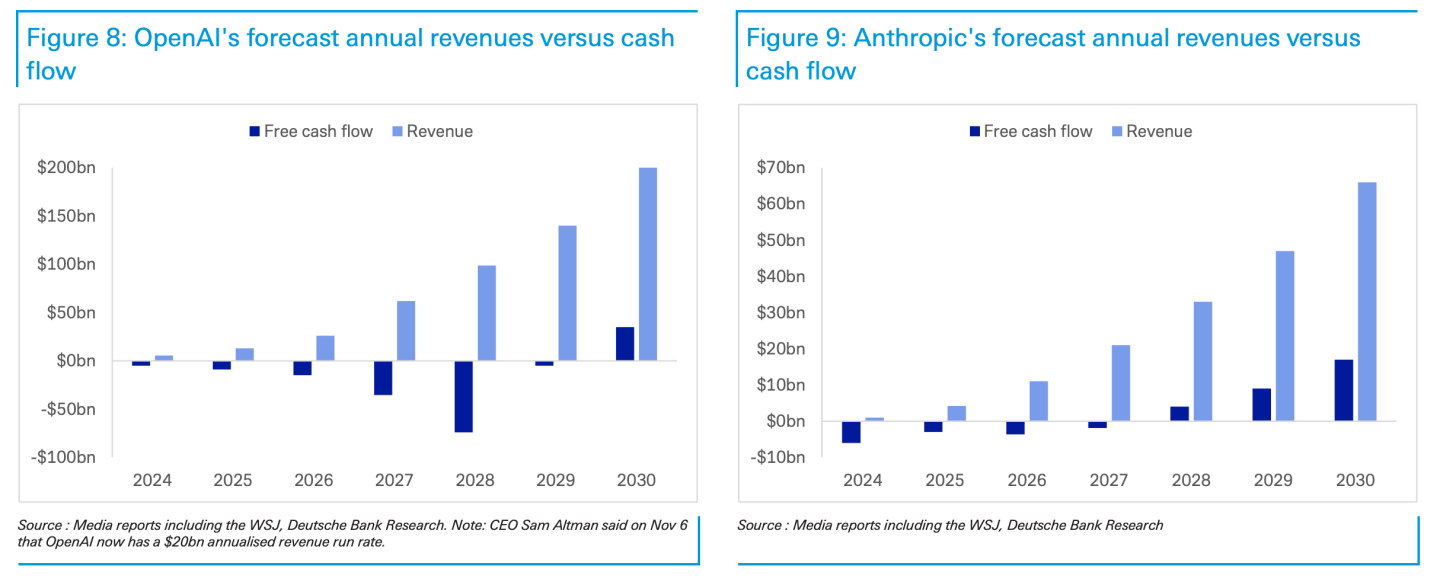
And Anthropic has an easier pathway to profitability than OpenAI, Deutsche Bank said:
Both Anthropic and OpenAI were contacted for comment by Fortune.
If Anthropic were to go public, it would be in an environment filled with worries about bubble-like activity. The Bank of England warned on Tuesday that “many risky asset valuations remain materially stretched, particularly for technology companies focused on Artificial Intelligence (AI). Equity valuations in the U.S. are close to the most stretched they have been since the dot-com bubble, and in the U.K. since the global financial crisis (GFC). This heightens the risk of a sharp correction.”
U.K. pension funds have been quietly reallocating their investments away from U.S. tech equities for this reason, the FT reported.
That followed remarks by former Reserve Bank of India Governor Raghuram Rajan, who spoke at a Clifford Capital Investor Day in Singapore. “We are in a period where there’s ample credit, and the Fed is cutting,” Bloomberg quoted him as saying. “That is the time when the risks build up more. So this is a time to be really more careful.” Rajan is now a finance professor at the University of Chicago.
And Bank for International Settlements General Manager Pablo Hernández de Cos warned in a speech that there was too much liquidity being offered to non-bank financial institutions to do leveraged trades on government debt. Although he did not link that to the stock markets, it dovetailed with the theme that asset markets are awash with too much cheap cash.
“In recent years, hedge funds have been able to borrow amounts equal to or higher than the market value of the collateral provided—that is, without any discount, or haircut, protecting the cash lender from market risk,” he said. “Around 70% of bilateral repos [a short-term borrowing tool based on a repurchase agreement] taken out by hedge funds in U.S. dollars and 50% in bilateral repos in euros are offered at zero haircut, meaning that creditors are not imposing any constraint on leverage using government bonds.”
Burry, the investor who correctly called the 2008 financial crisis, appeared on a podcast with Michael Lewis, author of The Big Short, to describe why he closed his investment fund. He thinks there is a bubble in tech stocks and wants to short the market, but he has clients who want to be long on stocks. “I think that we’re in a bad situation in the stock market. I think the stock market could be in for a number of bad years. And I think it could be a longer bear market more akin to 2000,” Burry said. “This bubble looks an awful lot like the dot-com bubble.”
In Washington, D.C., Trump said he had settled on a replacement for the Fed’s Powell. The markets interpreted that as meaning the Fed would be likely to continue cutting rates, thus adding more liquidity to markets that are already near their record highs. The CME FedWatch tool—which shows bets on Fed fund futures—gave a 90% chance of a 0.25% cut coming in December and a 40% chance of another one being delivered in March 2026.
Here’s a snapshot of the markets ahead of the opening bell in New York this morning:
- S&P 500 futures were up 0.12% this morning. The last session closed up 0.25%.
- STOXX Europe 600 was up 0.14% in early trading.
- The U.K.’s FTSE 100 was down 0.19% in early trading.
- Japan’s Nikkei 225 was up 1.14%.
- China’s CSI 300 was down 0.51%.
- The South Korea KOSPI was up 1.04%.
- India’s NIFTY 50 is down 0.18%.
- Bitcoin rose to $92.8K.
