
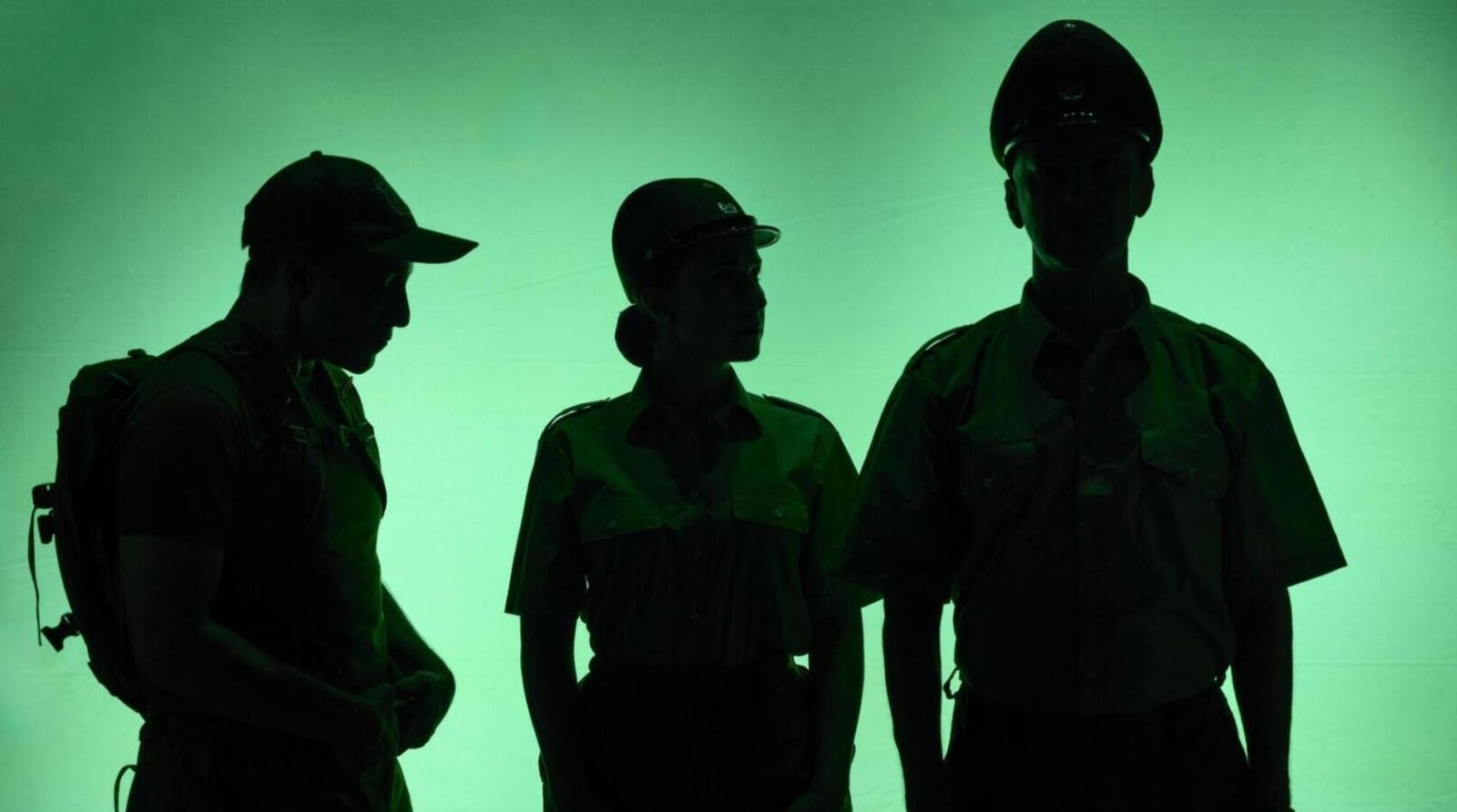
There were two key themes running through this year’s Teatro a Mil, the Chilean capital’s long-running theatre and performing arts festival. “Yes, Theatre Matters” may have been the festival’s tag line but the role and responsibilities of the artist, most notably at a time of economic precarity, proved a key theme. Crucially, intersecting with this was the relationship between theatre and democracy with many of the productions I saw during the final week of the festival asking questions about ethics, political activism and the faultlines of Chile’s democracy. Platea week at Teatro a Mil this year brought together 418 theatre professionals from 34 countries for a range of pitches, works in progress, productions and discussions — the fragility of democracy was central to many of these events.
La nueva obra/The New Work presented by Chile’s Teatro La María and seen at Matucana 100 cultural centre, has members of a theatre company take drastic steps when they can’t pay rent on the storage spaces for their sets. A series of vignettes follow with desperate times calling for desperate measures. A lovely sketch where one of the actors (Rodrigo Soto) just replies sí (yes) to any question that comes his way is a comment perhaps on an era of automated responses to complex questions or a response to a culture where gap between signifier and signified is ever wider. The different scenarios see the company ask: what is new or novel in theatre? Where do the bounds of legality lie? And what can be justified in the pursuit of art? These are topical questions as artists try and make work at a time when the far right is knocking at the door. Chile elected a new far right President in December 2025, José Antonio Kast, an open admirer of Pinochet and it is not yet clear what he will introduce or what the impact will be on culture when he takes power on 11 March of this year.

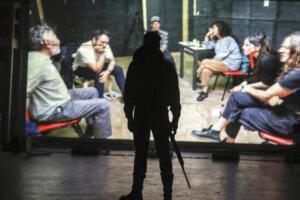
The company discuss their predicament in La nueva obra (The New Work). Photo: Luis Lobos
The sense of a society on the edge is all too present in La nueva obra as the video footage shows the company debating their difficult economic situation; scenarios enact the solutions they deploy (without much success) to address the debt — including a hapless attempt to transport heroin as drug mules. The company, however, keep at it, they are keen to present the work of the enigmatic playwright Vladimiro Navarro, and refuse to give up. The piece may feel like a work in progress that hasn’t quite come together — a series of vignettes rather than a fully rounded work — but it is still smart, sharp theatre-making, asking important questions about what theatre needs to do and how to ensure that it remains a viable and ethical workplace for those in employment. Alexandra von Hummel and Alexis Moreno’s direction is both playful and precise.
Argentine theatre-maker Federico León brought his witty, cerebral El Trabajo/The Work to the festival for a three-night run at Teatro La Memoria. Inspired by the theatre workshops he has run for the past 15 years at the theatre at his home, the piece presents a trio of performers in a series of vignettes pushing at the boundaries of what might be seen as permissible in theatre. What does experimental theatre really look like seems to be the question at the heart of the piece as a trio of performers seek new ways of making that break with their established behavioural patterns. Matías (Federico León) likes to be in control; words are his weapons and with them he dissects the conduct and practices of Marian (Santiago Gobernori) and Dina (Beatriz Rajland). The trio try things out, presenting exercises that seek to take them out of their comfort zone. At one point, Matías takes away Dina’s walking stick, leading to a routine where a series of ‘crutches’ (both physical and emotional) are forensically examined. These include psychological terror, complicity and word play. But is it ethical or appropriate to remove the walking stick of an octogenarian who relies on it for movement?
The rehearsal games see Matías become a dog, lured into a cage by Marian with a combo of sweet and sour goodies. Matías’ word games and physical dexterity allow him to render a virtuoso performance but is this ‘good’ acting? What does it mean to become another? Does one ever stop being oneself? What is the self? How far can you push yourself as an actor? What does it mean to evaluate what you do? In effect the exercises are a series of tests to explore these questions.

Beatriz Rajland as Dina in El trabajo (The Work) directed by Federico León. Photo: Wo Portillo.
What the piece shows is how far acting is driven by words and how words control what is undertaken and why. 87-year-old Rajland delights with her no-nonsense pragmatism but there are moments when her ageing body is out of sorts, certain things it cannot do. It’s a show stealing performance that Rjland gives as Dina. El trabajo is in dialogue with an earlier film León made with Martín Rejtman, Entrenamiento elemental para actores/Elemental Training for Actors (2009) which similarly explored performer training and its ethics. Both revolve around dialectics and tensions – one of the funniest scenes in El trabajo sees a brownie and lemon pie brought together to create a brownie pie. Acting is also about transformation and the games played by the performers play with this idea of becoming another — at one point the trio remove the doors to the rehearsal room and replace them with a pair of revolving saloon doors. Theatre, the performance shows, is ultimately a process of becoming that never feels complete.

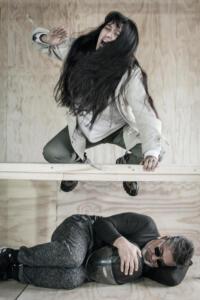
A frustrated Vanya and a sleeping Serebryakov in Vania. Photo courtesy of Teatro a Mil
Argentine director Guillermo Cacace provided one of the highlights of Teatro a Mil in 2024 with his intimate version of Chekhov’s The Seagull. His rendition of Vania, realised with a group of Chilean actors from the norther city of Antofagasta, is an altogether more boisterous affair, set on a cool, plywood set that feels isolated from the world beyond the estate that the characters live in or around. It’s a fast and furious staging, with a weepy Sonia (Francisco Díaz), eaten up by desire and a weary Vania (Paola Lattus) pining after Dolores Reina’s sporty but languid Elena. The staging is inventive with the plywood furniture turned on its head to conjure the different settings of Chekhov’s play. I wasn’t convinced the play was given the space to breathe but admired the inventive energy of Cacace’s bold and engaging production.
Uruguayan dramatist Gabriel Calderón frequently directs his own plays, Here Chilean director Cristián Plana stages Calderón’s Historia de un jabalí o Algo de Ricardo/Story of a Boar or Something about Richard which has been revised from its original 2020 single performer version to incorporate a second role. Here the actor who feels his time has come to take on a leading character after a lifetime in supporting roles is joined by his director. But increasingly, there is conflict in the rehearsal room as they prepare a production of Shakespeare’s Richard III. The busy rehearsal room is conjured through a circle of chairs, a rack of costumes and a table with refreshments for the cast. Actors and characters are referred to by name as the duo argue out the politics of the play. Marcelo Alonso’s director is cerebral and thoughtful; he’s done his research on the houses of York and Lancaster and the broader historical context for the play. Francisco Reyes’s actor just wants to be the centre of the production; he’s planning a showy performance and pays no attention to what might be ethical or appropriate.

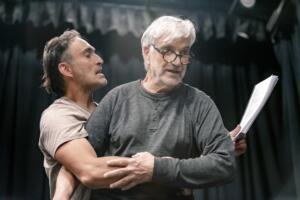
Marcelo Alonso and Francisco Reyes in rehearsal for Historia de un jabalí o Algo de Ricardo (Story of a Boar or Something about Richard). Photo: Ramiro Contreras.
Reyes excels as the vain performer who will do anything to ensure he has the final word and his moment to shine, even if it means getting the director sacked. He orchestrates a situation where he is invited to take over and further cement his own centrality within the production. His smug self-satisfaction is clear from the moment he steps on stage in his pink satin jacket and sunglasses, striding into the rehearsal room twenty-five minutes late as the centre of attention. He is convinced no-one else in the cast is up to his standards and is not interested in much the director has to say. Nothing and nobody will take away his moment in the sun or stop the hammy overacting that shapes his characterisation of the ambitious monarch.
Whereas Reyes strides and sprawls, Alonso’s director is more contained in his posture and moves. He observes and listens, and is less florid in his language and attitude. He finds it difficult to communicate with an actor who appears to be from a bygone era. The play provides a plethora of reflections on acting and on translation — Aguilar’s translation of Shakespeare’s play is frequently referred to — but there are also references to the search for Richard’s body in Leicester, to the historical context for the play and Shakespeare’s constraints in writing the play. Carolina Sapiain’s set is largely made up of the semi-circle of chairs that the Reyes and Alonso move around. Alonso also takes on the role of Richard’s nemesis Queen Margaret, delivering a clinical condemnation of her enemies with a regal wig and whitened face. Alonso’s poise as Margaret contrasts with Reyes’s jerky moves as Richard. The rhetorical delivery of Richard’s Act 1, Scene 1’s speech, “This is the winter of our discontent” is a counterpoint to the restraint of Alonso’s delivery of Margaret’s iconic speech :”Bear with me, I am hungry for revenge”. Indeed, reuniting what’s been divided may be easier in the kingdom of Shakespeare’s play than in the rehearsal room of these two polar-opposite practitioners.
Estampida humana/Human Stampede is further confirmation of the bold talent that Pablo Manzi displayed in A Fight Against… at London’s Royal Court Theatre in 2021. Co-directed with Andreína Olivarí, and presented by Compañía Bonobo, it’s an ambitious, beautifully performed piece that weaves together the story of a group of neighbours who are struggling with a homeless community in tents outside their apartment building and a failing home décor store that is unlikely to survive buyers taking their loyalties elsewhere. In the meantime, a radical left-wing unit in the police is planning an attack on the store as a way of announcing their political intentions and aspirations. They want to initiate a culture of change and transformation for Chilean society and violence seems to be the quickest way of achieving it.
The interlinking of these three stories is expertly done, and the results are brutally funny. Scenes of the desperate Hausman company executive team in their boardroom are projected on a video screen, as they bemoan the financial situation the company is in. They are, nevertheless, unable to provide a credible solution to the problem. The neighbours try and work out what their options are but again fail to act. There are arguments and debates but no real plan of action. Both groups are stuck in a culture of inertia where talking replaces doing. The police unit bicker – with one animated rookie member determined to produce his own version of the script despite the protests of his two more experienced colleagues. As he looks to go off the rails, they plan to take over the planned attack, but nothing goes quite as planned – and a human stampede prevails.


Neighbours discussing their predicament in Estampida humana (Human Stampede). Photo: Daniel Corvillón.
Estampida humana is hugely ambitious in its reach and ambition and in the complex web of links it presents between the three different converging storylines. The homeless are the target of the neighbours’ frustration with falling prices and crime as well as the Hausman’s store’s loss of appeal: a home décor store overrun with homeless persons isn’t quite the look that buyers aspiring to a smart home are looking for. There is quickfire dialogue, a welcome physicality to the performances and a strong sense of the absurd that runs through the scenarios — as with the rookie policeman exposed to Russian futurist magazines that have shaped his philosophical outlook on life. Estampida humana blends satire with heightened realism but never loses touch of the human dimensions of the stories of its characters where a sense of community has been lost and different factions wander without really connecting.
Juan Andrés Rivera and Felipe Olivares’ set allows for pockets of action and a veritable engagement with the action on screen. Performances are lithe with verbal and physical agility exposing the disconnects between the characters. Estampida humana reveals the unease that is often bubbling under the surface before societies snap, and the performance I saw demonstrates why Manzi and the company are at the forefront of contemporary Chilean theatre.


The world as a classroom bereft of students: La pequeña historia de Chile (The Little History of Chile). Photo: M. Viveros – Teatro Finis Terrae.
The responsibilities of a democracy also ran through Francisco Krebs’ energetic production of Marco Antonio de la Parra’s 1994 classic, La pequeña historia de Chile/The Little History of Chile, presented at Teatro Finis Terrae. Five teachers trapped in an empty classroom ruminate on Chile’s past and present, clad in shades of grey and beige, it’s not clear if they are alive or dead. The performance style is animated and stylised, the tale cautionary and intricate, navigating a complex web of references to Chile’s history. Pablo de la Fuente’s busy set of maps and papers was a fitting landscape for a messy play dealing with the mess of historical narratives that are never clean or straightforward. An outstanding cast delivers a complex play with gusto and verve.

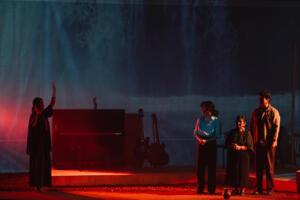
In search of justice: KIMVNTeatro’s Ütruf Tripay. Photo: Víctor Vivas.
KIMVNTeatro’s newest piece Ütruf Tripay, presented at UC Teatro and written and directed by Paula González Seguel, explores the illegal adoptions of indigenous infants during Pinochet’s dictatorship. Researched over five years, it is a dream-like piece drawing on the testimony of those who were displaced from their families in a state-endorsed system of adoption which ran between 1973 and 1990. Ütruf Tripay draws on five years of research on stolen Mapuche children with some terrifying statistics: 39,000 children are still to be reunited with their biological families; mothers were told their children had died; children were exported across Europe as well as in Chile. The tales of three key witness structure the piece: Alejandro Quezada who fronts an organisation that tries to reunite displaced children with their families; Alina Namuncura, who was adopted in Germany, and Jeannette Velázquez, a member of Sons and Mothers of Silence, an organisation that campaigns for justice for these children. The piece is haunting: a series of episodes where voices calling out from behind a glass door; moments of reflection from the lone Alejandro as he searches for a family that he may never find; haunting piano melodies that evoke a past that remains unknowable. Andrea Contreras proffers a scenography of loss and displacement as the cast of seven wander across the stage absent and adrift. The piece has something of a courtroom feel also with Jeanette’s legal discourse addressing the audience as a jury. Multiple dramatic registers come in to play in a production that refuses to see ‘reality’ as a single theatrical idiom.

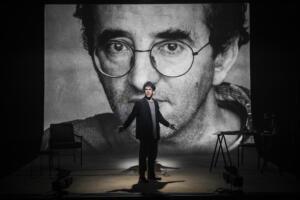
Renato Livera in Luiz Felipe Reis’s Desierto (Desert, Brazilian title “Deserto”), presented by Polifônica. Photo: Renato Mangolin
There were monologues galore at this year’s festival, perhaps a growing indication of a theatre culture where costs are shrinking the resources available for making work. Particularly impressive was Brazilian director Luiz Felipe Reis’s Desierto/Desert, presented by Polifônica, which revolved around the life and works of the Chilean author Roberto Bolaño who spent much of the latter part of his life in Barcelona. Renato Livera held the stage as the writer, wracked by doubt and illness; Bolaño died of liver failure in 2003 while awaiting a liver transplant. He was fifty years old. In many ways the piece is about the role of the writer with a restless Bolaño sitting at his desk ruminating on literature and its purpose but also engaging with an audience (in the recreation of a 2002 lecture). Livera uses a distinctive pair of glasses to take on the role of Bolaño, with reflections on exile (“I don’t believe in exile” says the Barcelona-based Bolaño) and on the abilities of writing to transcend (or not) the violence of the world. The text embeds fragments of Bolaño’s best known works including his epic 2666 and The Unknown University, identifying a series of patterns in his writing — the role of the writer, marginalisation, illness — and influences — most notably, Nicanor Parra and Mario Santiago.
Livera’s performance impresses because he doesn’t imitate Bolaño but rather opts for an approximation that feels playful: a dialogue with the audience and the screen at the back of the stage of GAM’s Sala A2 where projections provide a sense of Bolaño’s world. Desierto is a dialogue — the actor is often dwarfed by a giant image of the novelist on screen — that celebrates the power of art to challenge and disturb, to imagine a different world and conjure it through writing, to find poetry and agency in the most unlikely of places and sources.


Ricardo Bromley’s exquisite scissor dance in El rincón de los muertos (The Corner of the Dead). Photo: Paola Vera Centro Cultural PUCP
Worth highlighting also was Peruvian actor Ricardo Bromley’s virtuoso performance in Sebastián Rubio’s El rincón de los muertos/The Corner of the Dead, which played at the Teatro Mori Recoleta. Co-directed by the author with Yanira Davila, it’s a highly personal piece working through the history of Ayacucho – the name combining the words for death and eating. Ricardo brushes through its history and conflicts (including enforced disappearance and civil unrest in mapping his own journey to theatre. Ricardo’s influences are eclectic and unusual and include an admiration of Chaplin and his extraordinary scissor dancing where past and present come together in a celebration of the living and dead.
Mariano Saborido also gave an impressive performance in Argentine writer Santiago Loza’s Viento blanco/White Wind, as the repressed Mario, eking out an existence running a guesthouse with his mother in an isolated corner of Argentina. He finds a series of emotions come to the surface when his childhood best friend José returns to the town to visit. Saborido moves from coy naturalism to full melodrama and Hammer Horror in capturing the emotional rollercoaster ride he embarks on as a fierce desire takes hold. The performance was a feat even if Santiago Loza’s play felt trapped in an overly melodramatic register. Dramatic lighting by Matías Sendón provided an eerie atmosphere in Matucana 100’s Espacio Patricio Bunster.
With over 100 productions both in the capital and in eight different regions, and with over 350,000 spectators over its four-week duration, Teatro a Mil in its 33rd year, continues to prove a major meeting point for the performing arts in Latin America as its 2026 edition proved all too clearly.
Teatro a Mil ran from 3 to 30 January 2026
This post was written by the author in their personal capacity.The opinions expressed in this article are the author’s own and do not reflect the view of The Theatre Times, their staff or collaborators.
This post was written by Maria Delgado.
The views expressed here belong to the author and do not necessarily reflect our views and opinions.
