
 On December 24, 1920, the young fireman and future fire chief Richard Norris, who had recently returned from World War One, was nearly permanently injured trying to extinguish the last broom factory fire recorded in the history of Plattsburgh, NY.
Broom making was introduced to the Mohawk Valley in the 1830s, and a broom factory existed in Plattsburgh in Clinton County in the 1840s. Brooms were just another necessary consumer item that area entrepreneurs provided to the regional market.
Broom corn was used in making these brooms. It’s not actually corn, but a variety of sorghum used primarily to make brooms. Although Benjamin Franklin has often been given credit for introducing broom corn to America, recent research suggest the seed arrived with a ship of enslaved people from Africa.
In the 1820s many Clinton County farmers produced broom corn. In 1821 Robert Platt of the town of Peru, Nathaniel Nichols of Champlain and Benona Ladd of Chazy were recognized at the Clinton County Fair for their broom corn harvest. That year Levi Marshall from Beekmantown had the best broom corn acreage.
To win this award one only had to produce 10 rods of a high quality product. Awards for other crops were for .5 or 1 full acre. In 1845, New York State Agricultural Society was still offering recognition for the best broom corn acreage but crops appear to have been more substantial in southern and mid-western states.

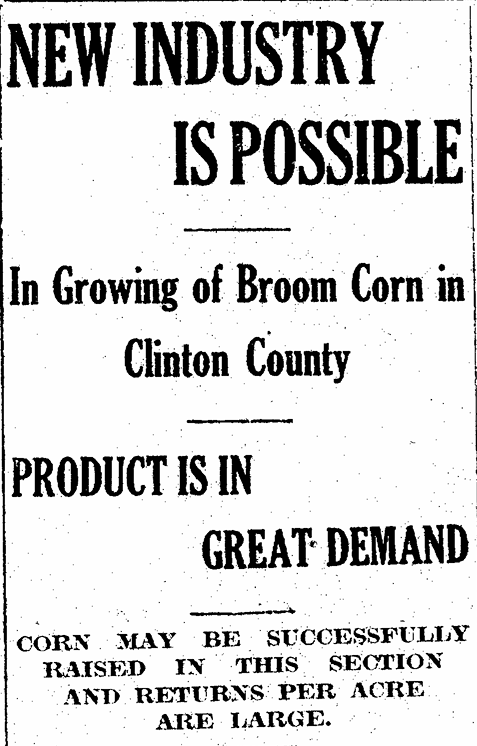
Interest in raising broom corn appeared again in 1916. In March, the County Fair management, through the Clinton County Agricultural Society’s office of their President E. F. Botsford, offered free broom corn seeds to those interested in growing what was suggested to be not only a lucrative crop, but a crop with a local market.
The local market was notably the Plattsburgh Broom Company, which offered 1st and 2nd prizes at the fair for the top bundles. They promoted a US Department of Agriculture booklet on how to grow broom corn and provided seeds for 150 farmers.
That April, an article in the Plattsburgh Sentinel promoted the planting of broom corn with the Clinton County Agricultural Society distributing seeds to anyone interested. In the fall, at the fair, only the Valley Grange of Ellenburg offered a showing of broom corn. There is no record about a prize.
The traditional broom was constructed from a bundle of twigs tied to a stout pole. In the 19th century larger corn broom operations were operated by broom makers, as Henry Rozier, a black Canadian prisoner in Dannemora Prison, was identified in the 1880 census. He was the only broom maker in the prison.
The 1920 census pointed out that Plattsburgh had many broom makers with 15 families connected to the broom manufacturing industry. Some worked on the handles and some on the machines. Nineteen-year-old Harvey Bullis was a corn sorter.
Frank and Louis Fifield were identified as owners of a broom factory in 1920, but this is difficult to confirm elsewhere. Frank Fifield was involved in a tragic accident at the Caroline Street broom factory in August of 1920 when an elevator he was taking down from the 3rd floor badly crushed a man who mistakenly was retrieving broom corn seed for his chickens from the elevator shaft. Alvin Martin died from his injuries in December and is buried in Plattsburgh’s Riverside Cemetery.
The Plattsburgh Broom Company of the 1840s on Oak Street burned in 1915 and then moved to Caroline Street. When they reopened they boasted having improved machinery, making a higher level of broom and employing from 30 to 50 people.
F rancis Sargent had a broom factory on Bridge Street in November of 1867. He purchased his broom corn from the south. In 1868 his factory offered “worked up” broom corn for sale.
In May of 1868, Mr. P. Girard, advertised that he had formerly worked with Francis Sargent, and that he and L. Chauvin had opened a broom and brush factory in Walkers & Co Planing Mill, also on Bridge Street called the “Union Broom Factory.” Girard appears to have had access to local supplies of broom corn which could be made up quickly into brooms and at a reasonable cost.
The last broom factory in Plattsburgh was on Peru Street – it burned in December of 1920 and was owned by the Stower Brothers.
There was certainly a market for brooms in Plattsburgh. In November 1827, Edwards & Campbell sold corn brooms, “large and small,” along with a myriad of other products such as fabrics, artist supplies and groceries. In 1849, Nichols & Lynde advertised a stock of 50 dozen brooms and a stock of 100 dozen in 1854. And like any market, prices depended on availability.
It was reported in 1875 that the price of broom corn fluctuated more than any other crop, and in 1910 the cost of broom corn was making brooms very expensive. In May 1920 there was an article in the Plattsburgh Daily Republican about how “club girls” (members of local women’s clubs) could make money making brooms from the broom corn which grew so well in the southern states.
 This program, under the supervision of the United States Department of Agriculture, suggested that communities would buy machines for the young women to use. After they paid for the use of the machines, they could profit from their work.
Broom factory fires seemed to be as common as starch factory fires. Elizabethtown lost their broom factory in 1879. The Plattsburgh factory first burned in 1915 and burned again in 1920.
Local investors encouraged them to continue, but the December 1920 fire ended large scale broom making in Plattsburgh. In 1933, broom corn was promoted as a decorative plan with a tropical air, or in a broom, sturdy with a lacquered handle on sale for $1.
It was still grown elsewhere and a new high price for a ton was set in California. Our local newspapers stopped referencing broom corn brooms in the early 1990s.
Read more about the history of Clinton County.
Photos, from above: Workers pose with brooms they made at the Range Broom Factory in Minnesota in the 1930s (courtesy Minnesota Museum of Mining); A broom corn revival article in the Plattsburgh Sentinel, April 21, 1916; The Acme Broom Works on Margin Street in Westerly, Rhode Island, which operated in the early 20th century; and inside the Whitmyer Broom Factory in Schenectady, 1947. Harvey Whitmyer was the sole operator of the factory (Grems-Doolittle Library, Union College).
