
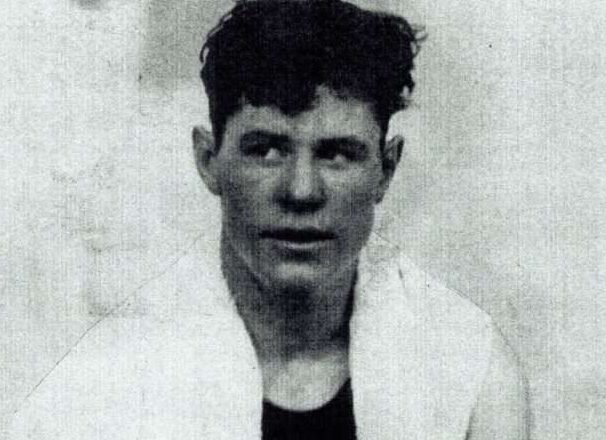
 Fans might have easily forgiven Indian Lake, NY pitcher Jimmy Slattery for being on the losing end of a 9-0 shutout against rival Warrensburg. Slattery had rushed back to the Adirondacks after winning a professional light heavy-weight boxing match by unanimous decision at Coney Island Stadium the previous evening.
“Jimmy Slattery of Buffalo, who pitched the first five innings for the Indian Lake team, returned yesterday morning from New York, where on Saturday night he defeated Maxey Rosenbloom in an important bout,” The Glens Falls Times reported on August 29, 1925.
Slattery would fight Rosenbloom at least seven times over his career.
Slattery mixed amateur baseball with professional boxing in the summer of 1925, when he trained at Indian Lake. “Mr. and Mrs. Harold Yandon attended the ball game Sunday at Indian Lake between Olmstedville and Slattery’s team,” The North Creek Enterprise reported. “Score 2-3 in favor of Slattery, the professional prize fighter.”
 Slattery, commonly known by the nickname “Slats,” had celebrity status in the region. “Jimmy Slatttery of Buffalo, who is spending his vacation at Indian Lake, was in town Monday,” the Enterprise reported that August.
“Slattery was the fellow who fought with Slade in the ‘Milk Fund Fight’ pictures which were recently shown at O’Keefe Hall. He is a light heavy weight, and his defeat to Slade was the only time he has been beaten in the ring.”
Ringside Magazine called Slade’s win the “upset of the year.”
The New York Daily News “Milk Fund Fight” was a New York City boxing multi-fight program held annually for several years to raise money to provide milk to children of poor families.
Local sports fans made at least one road trip to watch Slattery fight, when he took on Paul Berlenbach that September. The “Astoria Assassin“ was then a power puncher and the world light heavyweight champion after taking the belt from Mike McTigue.
“Henry Farrell, Oscar Ordway, Carl Montgomery, Frank Husson and Guy St. Marie were in New York Friday to witness the Slattery Berlenbach match at the Yankee Stadium,” the Indian Lake correspondent reported in the Enterprise on September 17, 1925.
The 172-pound Berlenbach knocked out the 162-pound Slattery just one minute and 28 seconds into the the 11th round, ending what had been scheduled as a 15-round fight, according to BoxRec, a boxing history database.
James Edward Slattery, who was inducted into the Boxing Hall of Fame in 2006, was the light-heavyweight champion in 1927 and 1930. He had 111 wins, including 49 knockouts, in his professional boxing career, which he began in 1921, at either age 16 or 17, depending on which news report is correct.
He remembered watching heavyweight champion Jess Willard (1881-1968) train as a kid. Willard knocked out Jack Johnson (1878-1946) to win that title in 1915.
 His Irish-American father was a Buffalo firefighter and he fought most of his major fights at Buffalo’s Broadway Auditorium. His family called him “Shamus.”
“Fame came to Jimmy Slattey almost overnight as a ring celebrity,” The Glens Falls Times reported on March 19, 1924, after Slattery defeated Young Stribling, known as “The Georgia School Boy.”
Slattery lost 13 matches, of which he was knocked out four times. He trained at least twice at Lake Placid.
“Jimmy Slattery of Buffalo, well-known boxer, who has been stopping at the Northwoods Inn for six weeks, left for New York a short time ago to put the finishing touches on his match with Young Stribling of Georgia at Madison Square Garden Thursday night,” The Lake Placid News reported on March 26, 1926.
“While here, Slattery spent much of the time skiing and ski jumping, finding the Adirondack winter sports an ideal conditioner for his later intensive training work. He expressed himself as being much pleased with Lake Placid.”
Slattery had defeated Stribling two years previous. “Matched with the much press-agented Young Stribling, Slattery was regarded as a mere setup for the Georgia school boy,” The Glens Falls Times reported on March 19, 1924. “After holding Stribling even for three rounds, taking his best punches without suffering the slightest inconvenience, Slattery waded in and won the decision.”
 This time, the 172-pound Stribling won the 10-round fight against the 164-pound Slattery on points, according to BoxRec.
“Young Stribling of Georgia, last night in MSG, outpunched and outlasted in 10 rounds Jimmy Slattery of Buffalo. Stribling not only evened the score with Slattery, who gained a six-round decision over the Georgian two years ago, but did it in convincing fashion,” the Associated Press reported.
“Slattery was outpunched and outgeneraled except for occasional flashes and was on the verge of a knockout in the 7th round under a barrage of terrific right hooks to the jaw. Slattery fought on the defensive almost from the start to finish, but even his shiftiness failed to keep him out of the way of Stribling’s rushes and driving attack to the head and body.”
Stribling would later fight a losing battle with Max Schmelling. Slattery won another decision over Maxie Rosenbloom for the title in 1927, but lost to Tommy Loughran later that year.
In 1930, Slattery trained at Lake Placid before his fight with New York State Athletic Commission light heavyweight title fight with fellow Buffalo native Lou Scozzo. Slattery won back the title, but lost it again later that year to Rosenbloom in a heavy disputed and controversial decision.
In July of 1931, he trained at Speculator, in Hamilton County. “Jimmy Slattery, with six solid weeks of training behind him, should be in the park next Wednesday night when he meets Maxie Rosenbloom in a 15-round battle for the light heavy-weight championship of the world,” at Ebbets Field in Brooklyn, according to the Plattsburgh Daily Press.
“Slattery has been training at Speculator, N.Y., where Gene Tunney once conditioned himself. Confident that he is the best light heavy-weight in the world, Slattery has been taking this contest more seriously than any in his career.” Slattery lost the 15-round fight by unanimous decision.
Slattery, who was said to have been generous to the poor during the Great Depression, had his last sanctioned fight in 1934. He and his wife (who he had famously eloped with when she was 19) were divorced in 1940.
Slats remarried, but was committed by his second wife to Bellevue’s alcoholism ward in 1943. He suffered from tuberculosis later in life and died from the disease in 1960 in Buffalo.
That Erie County city (for which he had briefly worked in retirement) inducted Jimmy Slattery into the Greater Buffalo Sports Hall of Fame in 1992. A play, Jimmyland followed, and the city named a street in his honor in 2006.
In an interview about Slattery, was reported to have said.
“Jimmy liked to drink. Let’s face it. We all do. I like to drink. There’s no shame in that,” Buffalo Mayor Jimmy Griffin (four terms, 1978-1994) said about Slattery.
“What he [Slattery] did with his life, he enjoyed himself. That’s the way I’ll remember the guy. Down in the First Ward, people didn’t have a hell of a lot. They worked hard down there, and they played hard. Still do.”
In 2015 Buffalo’s first real sports celebrity was the subject of a biography by Rich Blake,
Read more about boxing history in New York State.
Illustrations from above: Jimmy Slattery; A traveling promotional “Milk Fight” lantern slide from the May 30, 1925 fight at Yankee Stadium with Mike McTigue vs. Paul Berlenbach, Jack Delaney vs. Tony Marullo, Jack Burke vs. Jimmy Slattery” (National Museum of American History); Broadway Auditorium in Buffalo, New York, circa 1914; and the cover of Slats: The Legend and Life of Jimmy Slattery.
John Warren contributed to this essay.
