

Her married status didn’t stop brothers Giuliano and Lorenzo di Piero de’ Medici fighting over her affections and she was muse to many artists, including Sandro Botticelli. Some even think she was the inspiration for Venus in The Birth of Venus, although as this was painted in around 1485, almost 10 years after her tragically early death at the age of 22 in 1476, it would have been an idealised image of her. But as Botticelli was so infatuated with her that he requested to be buried at her feet after his death, it is quite possible that he had indeed held her image in his mind all those years.
The style icons that followed in her wake came of age during the Italian Wars, a series of violent conflicts fought largely by Spain and France for control of Italy that raged from 1494-1559. Fashion was frequently used as a diplomatic tool, and Isabella d’Este, wife of Francesco II Gonzaga, the Marquis of Mantua was particularly skilled in these arts.
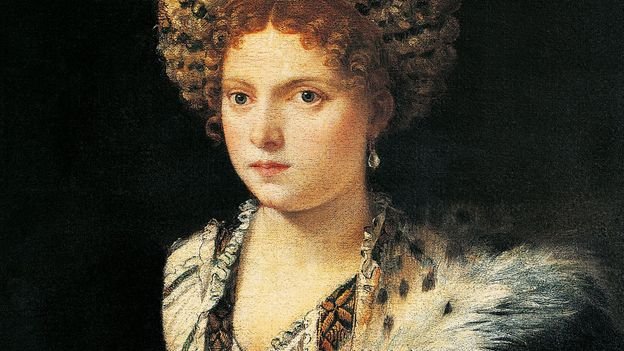
A renowned art patron and collector, Isabella was one of the most famous women in Renaissance Italy. Her innovative style choices saw her reputation as a trendsetter spread throughout Europe, however fashion for her was far from a frivolous pastime. Referred to as “Machiavelli in skirts,” by an early 20th-Century historian, a somewhat misogynistic phrase that nevertheless emphasises the level of her influence, her stylistic choices were “deeply embedded in strategies of statecraft,” says historian Sarah Cockram, who has written widely on Isabella.
Renaissance style wars
Communicating political allegiance via clothing was well understood in Renaissance Italy but could often be a risky business. When Isabella’s brother-in-law, Ludovico Sforza, Duke of Milan, sent her a luxuriant fabric embroidered with a Sforza motif in 1492 she immediately had a gown made of it to show off her affiliation to him while in Milan. However, when seven years later the King of France ejected Ludovico from Milan and Isabella’s relationship to him called into question her loyalty to France, she sought to assure the French ambassador, via her envoy in Venice, that should he visit her he would find her dressed head-to-toe in French fleur-de-lys.
Her reputation as a sophisticated arbiter of taste was also frequently leveraged for political influence, with gift-giving used to win the favour of those above her, and induce a desire to serve her needs in those below. Isabella’s perfumed gloves seem to have been a particularly potent source of influence, with the Queen of France desperate to obtain a pair. “What you want, if you’re going to survive the Italian Wars, is to be positively on the mind of the King of France and what’s more intimate than being on the Queen of France’s hand?” says Cockram.
